

When More Water Means Less Growth
Understanding how excess water affects roots, soil health, nutrient uptake and crop productivity — and learning how to water smarter, not more
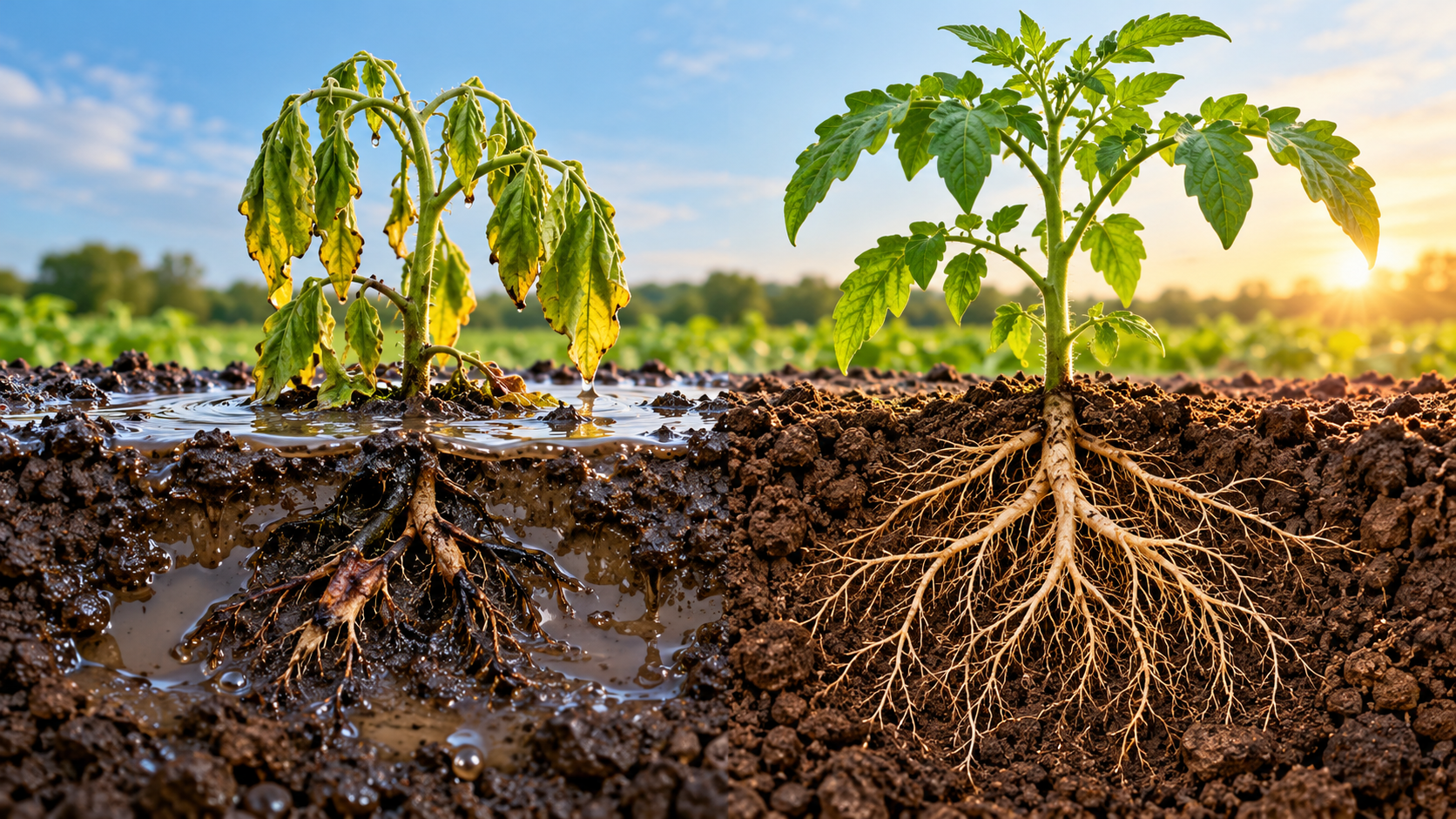
What if the very thing you do to keep your plants alive is slowly suffocating them? Many gardeners and farmers associate healthy crops with regular watering, lush green leaves and moist soil. But plants need more than water to survive. They also need oxygen around their roots. When the soil remains saturated for too long, excessive watering can turn a valuable resource into a serious threat to plant health, crop yield and farm profitability.
1. Introduction: When Good Intentions Become a Growing Problem
Water is essential for every stage of plant growth. It helps seeds germinate, transports nutrients from the soil, supports photosynthesis, maintains plant structure and regulates temperature. Without sufficient water, plants wilt, stop growing and eventually die.
However, there is a critical difference between providing adequate water and providing too much.
Overwatering occurs when water is supplied in quantities or at intervals that exceed the plant's requirements and the soil's ability to drain, store and release moisture. The excess water fills the air spaces between soil particles, restricting the oxygen supply available to roots.
This creates a condition in which plants may show symptoms similar to drought, nutrient deficiency or disease, even though the soil contains plenty of water.
For home gardeners, overwatering may cause yellow leaves, stunted growth and root rot. For farmers, the consequences can extend much further, affecting crop establishment, fertilizer efficiency, disease pressure, irrigation costs and final yield.
The important lesson is simple: successful irrigation is not about keeping the soil constantly wet; it is about maintaining the right balance of water and air in the root zone.
2. What Exactly Happens When Plants Receive Too Much Water?
To understand overwatering, it is necessary to understand how soil works.
Healthy soil contains a mixture of solid particles, water and air. The spaces between soil particles, known as pore spaces, hold water after irrigation and allow air to circulate through the root zone. The proportion of water and air changes according to soil texture, structure, rainfall, drainage and irrigation practices.
When soil receives an appropriate amount of water, some moisture remains available for plant uptake while excess water drains away and air gradually returns to the larger pores.
When excessive water accumulates, however, many of these pores become filled with water instead of air. Oxygen moves much more slowly through waterlogged soil than through air, making it difficult for roots to obtain the oxygen required for normal respiration.
Roots need oxygen to release energy from stored sugars and power essential processes such as nutrient absorption, cell maintenance and new root development. When oxygen becomes insufficient, these processes slow down or fail.
Prolonged saturation may cause roots to weaken, lose their ability to absorb nutrients efficiently and eventually die. Damaged roots may then become more vulnerable to soilborne pathogens, further aggravating the problem.
This explains an important agricultural paradox: a plant can stand in wet soil and still behave as though it is unable to obtain enough water.
3. Major Causes of Overwatering in Plants and Crops
Overwatering is not always the result of pouring too much water at once. In many situations, the problem develops gradually because irrigation is poorly timed, soil drainage is inadequate or the actual moisture requirement of the crop is misunderstood.
A. Watering According to a Fixed Schedule
One of the most common mistakes is watering plants every day or irrigating fields at fixed intervals without checking soil moisture. A schedule that works during hot, dry weather may become excessive during cloudy conditions, cooler weather or periods of rainfall.
Plants do not consume the same amount of water every day. Their requirements change with temperature, humidity, wind, sunlight, growth stage, root development and crop variety. Irrigation should respond to these changes rather than follow the calendar blindly.
B. Poor Soil Drainage
Even a moderate quantity of irrigation water can cause damage when the soil cannot drain properly. Heavy clay soils, compacted land, low-lying fields and areas with a shallow water table are particularly vulnerable.
If water remains around the roots for extended periods, the soil becomes oxygen-deficient. Repeated irrigation under these conditions can cause progressive root damage even when the quantity of water applied during each irrigation appears reasonable.
C. Excessive Rainfall Combined with Irrigation
Farmers sometimes continue irrigation according to their normal schedule even after receiving rainfall. If the rain has already replenished the root-zone moisture, additional irrigation may push the soil beyond its water-holding capacity.
This is especially problematic during the monsoon, when repeated showers may keep the soil wet for several days. Irrigation decisions should account for effective rainfall, not merely the number of days since the last watering.
D. Incorrect Irrigation Methods
Flood irrigation, poorly designed furrows, leaking pipes, damaged valves and incorrectly positioned sprinklers can distribute water unevenly. Some parts of a field may receive adequate moisture while other areas become saturated.
A farmer may mistakenly irrigate the entire field again because certain plants appear stressed, even though the real issue is uneven water distribution, damaged roots or a local drainage problem.
E. Overwatering Young Plants and Seedlings
Young plants have smaller root systems and require careful moisture management. However, frequent watering can become harmful when seedlings are growing in trays, nursery beds or poorly drained soil.
Excess moisture around seeds may interfere with germination and increase the risk of seed decay and damping-off. Young roots may also fail to develop properly when the surrounding soil remains continuously saturated.
F. Misjudging Soil Moisture by Appearance
The surface of the soil can appear dry while the deeper root zone remains wet. This often happens in containers, raised beds and fields with uneven soil texture.
Watering merely because the surface looks dry may lead to excessive moisture at root depth. The opposite can also happen: the surface may appear damp while deeper roots remain inadequately supplied.
Checking moisture at the actual rooting depth is therefore far more useful than judging the entire field by its surface appearance.
G. Believing That More Water Means Better Growth
Some growers associate rapid plant growth with abundant irrigation and assume that additional water will produce larger leaves, stronger stems and better yields.
However, plants can only use water at a rate determined by their physiological requirements and growing conditions. Beyond that point, additional water may provide little benefit and can cause serious damage.
The objective should be to maintain suitable soil moisture throughout the crop's growth cycle, not to keep the field continuously wet.
4. Warning Signs: How to Identify Overwatering Early
Overwatering can be difficult to diagnose because its symptoms often resemble those caused by drought, nutrient deficiencies, pests and diseases. Farmers and gardeners should examine several indicators together rather than rely on a single symptom.
Yellowing leaves: Lower or inner leaves may turn pale yellow as damaged roots struggle to absorb nutrients. In severe cases, yellowing spreads to newer leaves and the plant begins losing foliage.
Wilting despite wet soil: This is a particularly important warning sign. When roots are damaged by oxygen deficiency, they may be unable to absorb enough water to meet the plant's needs. Leaves droop even when the surrounding soil is wet.
Slow growth and weak plants: Damaged roots may no longer function efficiently. Seedlings may remain small, transplants may fail to establish and established crops may show poor canopy development.
Brown, black or soft roots: These can indicate severe root injury or root rot. Healthy roots are generally firm, while severely decayed roots may become dark, soft and unpleasant-smelling. Root appearance varies among species, so colour alone should not be treated as a definitive diagnosis.
Persistent wetness and standing water: These are direct clues that irrigation or drainage needs attention. Soil that remains saturated long after irrigation deserves investigation, especially if plants are showing stress.
Premature leaf drop, scorched margins and dying shoots: These symptoms may appear as the damage progresses. They suggest that the plant's water and nutrient supply has been disrupted, but other causes must also be considered.
Algae, moss or fungus gnats: These may appear around persistently wet growing media, particularly in nurseries, greenhouses and container gardens. Their presence does not, by itself, prove that overwatering is the main problem.
The most useful diagnostic approach is to compare plant symptoms with soil moisture, drainage behaviour, recent rainfall and irrigation history.
5. How Overwatering Damages Roots
Roots are the first major casualties of prolonged soil saturation.
Under normal conditions, roots absorb water and mineral nutrients while using oxygen for respiration. This process supplies the energy needed to maintain living tissues, produce new roots and support the growth of the entire plant.
When oxygen becomes scarce, root respiration is impaired. Fine feeder roots, which play a major role in absorbing water and nutrients, may stop functioning properly or die.
As root damage increases, the plant's ability to support its leaves, stems, flowers and fruits declines. The visible symptoms above ground are often the final expression of a problem that began beneath the soil surface.
Damaged roots may also create opportunities for certain soilborne pathogens to infect the plant. Organisms associated with root and crown diseases can cause further decay when environmental conditions favour infection.
This is why applying a pesticide or fungicide without checking soil moisture and drainage may fail to solve the underlying problem. If excessive water continues to deprive the roots of oxygen, the plant remains under stress even after a disease treatment.
6. The Impact of Overwatering on Soil Health
Overwatering does more than affect an individual plant. Repeated saturation can alter the physical, chemical and biological conditions of the soil.
Soil Compaction and Poor Aeration
Wet soil is particularly vulnerable to compaction when subjected to heavy machinery, livestock or repeated foot traffic. Compaction reduces the size and continuity of air-filled pores, restricting oxygen movement and root penetration.
The resulting conditions can create a cycle in which water drains slowly, roots grow poorly and further irrigation increases the duration of saturation.
Changes in Nutrient Availability
Waterlogged soil can undergo chemical changes because oxygen-dependent microbial processes become restricted or shift towards alternative pathways.
Nitrogen is particularly vulnerable. Under suitable conditions, nitrate can be lost through denitrification, a microbial process that converts nitrate into gaseous nitrogen compounds. Nitrate may also be carried below the root zone by drainage water.
These losses reduce fertilizer efficiency and may increase production costs. Excess irrigation can therefore waste both water and the nutrients that farmers have paid to apply.
Reduced Beneficial Root-Zone Activity
Many beneficial soil microorganisms depend on particular moisture and oxygen conditions. Prolonged saturation can alter microbial activity and the balance of organisms in the root zone.
This does not mean that all beneficial microorganisms die when soil becomes wet. Rather, the microbial community and its functions can change, potentially affecting nutrient cycling, root health and soil processes.
Surface Crusting and Erosion
In some soils, excessive irrigation or heavy rainfall can break down soil aggregates and contribute to surface sealing or crusting. Water flowing over the surface may carry away fertile topsoil, particularly on sloping or poorly protected land.
Maintaining soil structure, organic matter and suitable ground cover can help improve infiltration and reduce these risks.
7. How Overwatering Affects Crop Growth and Yield
The agricultural consequences of excess water depend on crop species, soil type, duration of saturation and the stage of plant development.
Germination and Early Establishment
Seeds require both moisture and oxygen to germinate successfully. If the seed zone remains saturated, oxygen availability may decline and germination can become uneven. Seeds may decay, seedlings may emerge weakly, and plant populations may fall below the intended level.
For crops such as pulses, vegetables and many field crops, poor establishment can create gaps that are difficult to recover from later in the season.
Vegetative Growth
During vegetative growth, damaged roots can restrict nutrient uptake and reduce the development of healthy leaves and stems. Some plants may initially develop lush foliage under high moisture and nutrient availability, but excessive vegetative growth does not necessarily translate into better productivity.
Weak roots, poor aeration and imbalanced growth can leave the crop more vulnerable to subsequent stress.
Flowering and Fruit Formation
Excess water during flowering and reproductive development can interfere with normal plant function. Depending on the crop and environmental conditions, plants may experience flower drop, reduced fruit set or poor reproductive development.
These effects are not identical across crops, and reproductive problems can also arise from heat, nutrient imbalance, pests and other stresses. Nevertheless, prolonged waterlogging is an important factor to investigate when reproductive performance declines.
Fruit and Produce Quality
Excessive or fluctuating soil moisture can contribute to certain quality problems. In susceptible crops, irregular water uptake may increase fruit cracking, while prolonged wet conditions can favour diseases affecting leaves, roots and harvested produce.
The effects vary by species, variety and growing conditions. More irrigation is not automatically associated with better-sized, better-tasting or more marketable produce.
Economic Losses for Farmers
The cost of overwatering extends beyond lost yield. Farmers may pay for unnecessary pumping, electricity, diesel, labour and irrigation maintenance. Nutrient losses may require corrective fertilization, while root diseases and poor crop establishment can increase the need for replanting or crop protection measures.
When these costs accumulate across a season, inefficient irrigation can reduce profitability even if the crop survives.
8. Why Different Soil Types Respond Differently to Excess Water
Understanding soil texture is essential for preventing overwatering because the same irrigation practice can produce very different results in different fields.
Sandy soil: Sandy soil generally allows water to drain relatively quickly. It often requires more frequent irrigation than heavier soils, depending on crop and weather conditions. However, applying excessive water can move nutrients below the active root zone before plants can absorb them.
Clay soil: Clay soil retains water for longer because its fine particles and pore structure can restrict drainage. Frequent irrigation may keep the root zone saturated, particularly when the soil is compacted or the water table is high.
Loamy soil: Loamy soil often provides a favourable balance between water retention, drainage and aeration. Nevertheless, even good loamy soil can become waterlogged if irrigation exceeds the soil's capacity to store and drain water.
Compacted soil: Compacted soil deserves special attention regardless of its texture. Compaction reduces the number and continuity of large pores that normally support drainage and air movement. Water may accumulate near the surface or run off instead of entering the root zone effectively.
Farmers should therefore assess the soil's physical condition and drainage behaviour before deciding how much water to apply or how frequently to irrigate.
9. Practical Ways to Prevent Overwatering
Preventing overwatering does not necessarily require expensive technology. Many improvements can begin with careful observation, better irrigation timing and a clear understanding of the field's soil conditions.
1. Check Soil Moisture Before Irrigating
Do not irrigate simply because a particular number of days has passed since the previous watering.
Examine the soil at a depth that represents the active root zone. A hand-feel assessment can be useful for small gardens and many field situations, while a soil auger, probe or moisture meter can help assess deeper layers.
If the root zone is already adequately moist, irrigation may be postponed until the crop needs additional water. The appropriate threshold depends on soil texture, crop sensitivity, rooting depth and growth stage.
2. Irrigate According to Crop Requirements
Different crops have different water needs. Leafy vegetables, fruiting crops, pulses, cereals and perennial plants cannot all be managed using the same irrigation schedule.
Even within one crop, water requirements change between germination, vegetative growth, flowering, fruit development and maturity.
A good irrigation plan accounts for crop type, growth stage, local weather, soil moisture and the effective rooting depth.
3. Avoid Unnecessary Irrigation After Rainfall
Rainfall should be included in irrigation decisions. If a shower has sufficiently replenished the root zone, further watering may not be necessary.
However, light rainfall may wet only the surface and provide little moisture to deeper roots. Check the soil rather than assuming that every rainfall event either eliminates or completely fulfils the crop's irrigation requirement.
4. Improve Field Drainage
Where water regularly accumulates, investigate the underlying cause. Appropriate measures may include maintaining field drains, clearing blocked outlets, correcting local depressions, improving surface grading or using raised beds for suitable crops.
In areas affected by a high water table, drainage improvements may require a more detailed assessment of groundwater conditions and the feasibility of safely discharging excess water.
5. Consider Drip Irrigation
Drip irrigation can deliver water close to the root zone and reduce unnecessary wetting of the soil surface and foliage. It can also improve water-use efficiency when properly designed and maintained.
However, drip irrigation is not automatically immune to overwatering. Excessive operating time, incorrect emitter spacing, leaking lines or poorly matched discharge rates can still saturate the root zone.
6. Use Mulching Appropriately
Organic mulches, such as crop residues and suitable plant materials, can reduce evaporation from the soil surface and help moderate soil temperature.
Because mulch conserves moisture, irrigation frequency may need to be reduced after mulching. Monitor the soil beneath the mulch rather than continuing the previous watering schedule unchanged.
Mulch should also be managed carefully around stems and plant crowns to avoid creating persistently wet conditions in sensitive areas.
7. Prevent Soil Compaction
Avoid unnecessary movement of heavy machinery on wet fields. Repeated traffic when soil is highly moist can damage soil structure and make drainage problems worse.
Where compaction is suspected, identify its depth and extent before choosing a corrective method. Mechanical loosening may help in some situations, but working wet soil can aggravate the problem.
8. Maintain Irrigation Equipment
Check pipes, valves, emitters, sprinklers and pumps regularly. Uneven distribution can lead to excess moisture in one section of a field and inadequate moisture in another.
Correcting leaks and improving uniformity can reduce both water waste and crop stress.
9. Adjust Irrigation During Cool and Cloudy Weather
Water loss through evaporation and plant transpiration generally changes with weather conditions. During cool, humid or overcast periods, many crops use less water than they do during hot, sunny and windy conditions.
Reduce irrigation when monitoring indicates that the soil is retaining sufficient moisture. Do not automatically apply the same quantity used during hotter weather.
10. Keep a Simple Irrigation Record
Record irrigation dates, approximate duration or quantity, rainfall, soil moisture observations and any visible crop symptoms.
Over time, these records can reveal recurring patterns. For example, a field that remains wet for several days after irrigation may need a drainage assessment or a change in irrigation duration rather than additional fertilizer or crop protection products.
10. How to Rescue Plants That Have Already Been Overwatered
When overwatering has already occurred, the immediate objective is to stop further saturation, restore suitable root-zone aeration and assess the extent of damage.
Step 1: Stop unnecessary irrigation.
Pause watering while the root zone remains excessively wet. Do not resume simply because the leaves are drooping; first determine whether the roots are suffering from excess moisture or an unrelated problem.
Step 2: Remove standing water where feasible.
Clear blocked drainage channels and outlets, and allow excess water to leave the affected area where the land's drainage design permits. Avoid creating erosion or transferring contaminated runoff to neighbouring fields or water bodies.
Step 3: Inspect the roots.
In potted plants or a small number of affected plants, examine the roots carefully. Firm, healthy roots are generally a good sign, whereas soft, decayed roots may indicate severe damage. In field crops, inspect a few representative plants rather than disturbing the entire field.
Step 4: Improve drainage and aeration.
For container plants, check that drainage holes are open and remove collected water from saucers. For field crops, address blocked drains or local water accumulation. Avoid digging or cultivating saturated soil because this may worsen compaction and structural damage.
Step 5: Remove severely damaged plant material when appropriate.
Dead or decaying foliage can be removed from affected container plants, but healthy leaves should not be stripped unnecessarily. If root decay is extensive, recovery may be limited.
Step 6: Avoid immediate overcorrection with fertilizers.
Yellow leaves and weak growth do not automatically indicate a fertilizer deficiency. Adding more fertilizer to a plant with damaged roots may not correct the problem and can increase salt stress. Reassess nutrient needs after drainage and root function improve.
Step 7: Monitor recovery.
Look for improved leaf firmness, healthy new growth and the development of functional roots. Recovery depends on the severity and duration of waterlogging, the crop's tolerance and whether root disease has developed.
If wilting persists after the soil has drained, investigate other possible causes, including root disease, vascular disorders, pests, nutrient problems and inadequate moisture deeper in the root zone.
11. The Difference Between Overwatering, Underwatering and Waterlogging
These conditions can produce similar symptoms, but their causes and management requirements differ.
Overwatering describes irrigation that exceeds the plant's needs or the soil's capacity to manage the applied water. It can occur even when standing water is not visible.
Waterlogging occurs when the soil becomes saturated or nearly saturated long enough to restrict oxygen availability in the root zone. It may result from excessive irrigation, heavy rainfall, poor drainage or a high water table.
Underwatering occurs when insufficient water is available to the roots to meet the plant's requirements. The soil may be too dry, irrigation may not reach the active roots, or the roots may be unable to access the available moisture.
The difficulty is that both overwatering and underwatering can cause wilting, yellowing, leaf drop and stunted growth.
The simplest starting point for distinguishing them is to examine moisture at root depth. Wet soil combined with wilting should prompt an investigation of drainage and root health. Dry soil combined with wilting points towards inadequate moisture, although other causes remain possible.
Correct diagnosis is essential because adding water to an overwatered plant can worsen the problem, while withholding water from a genuinely dehydrated plant can cause further damage.
12. Common Myths About Overwatering
Myth 1: Every plant needs water every day.
Reality: Water requirements depend on crop species, growth stage, soil type, weather and rooting depth. Some plants need frequent irrigation, while others require longer intervals between watering.
Myth 2: Yellow leaves always mean nitrogen deficiency.
Reality: Yellowing can result from root damage, waterlogging, nutrient imbalances, pests, diseases and other environmental stresses. Check the soil and roots before applying corrective fertilizer.
Myth 3: A wilted plant always needs more water.
Reality: Wilting can occur when roots are unable to absorb water because they are damaged or deprived of oxygen. Check root-zone moisture before irrigating again.
Myth 4: Sandy soil cannot be overwatered.
Reality: Sandy soil generally drains faster, but excessive irrigation can still waste water and leach nutrients below the root zone. Poor drainage may also occur where a restrictive layer exists beneath the sand.
Myth 5: Drip irrigation completely eliminates overwatering.
Reality: Drip irrigation can improve precision, but excessive run times, faulty emitters and poor scheduling can still create saturated soil.
Myth 6: More water always produces more yield.
Reality: Crop performance depends on balanced water supply, oxygen availability, nutrient management, root health and many other factors. Excessive water can reduce rather than improve productivity.
13. A Practical Irrigation Checklist for Farmers and Gardeners
Before every irrigation, follow these simple checks:
Check soil moisture at the active root depth.
Consider recent rainfall and the weather forecast.
Confirm that the crop actually requires additional water.
Inspect drainage channels and look for standing water.
Check for wilting, yellowing or other signs of root stress.
Verify irrigation equipment and water distribution.
Adjust irrigation quantity and duration to field conditions.
Record irrigation and observe the crop's response.
This checklist is particularly useful when several people are involved in farm irrigation. A consistent decision-making process can reduce unnecessary watering and help identify problems before they become widespread.
14. The Role of Smart Water Management in Sustainable Agriculture
As agriculture faces increasing pressure on groundwater resources, energy costs and soil productivity, irrigation efficiency is becoming an essential part of sustainable farming.
Efficient irrigation does not mean supplying the minimum possible quantity of water regardless of crop needs. It means applying the right quantity, at the right time, in the right place, while maintaining conditions that allow roots to function effectively.
Soil moisture sensors, weather-based irrigation scheduling, evapotranspiration estimates and well-designed drip or sprinkler systems can help farmers make better decisions. However, technology works best when combined with practical field observation and an understanding of local soil and crop conditions.
Healthy soil structure also matters. Appropriate organic matter management, reduced compaction, suitable drainage and effective ground cover can help maintain a favourable balance between water retention and aeration.
The ultimate goal is to avoid both extremes: drought stress caused by insufficient water and root stress caused by excessive moisture.
15. Final Thoughts: Let the Soil Guide the Water
Water is one of agriculture's most valuable resources, but its benefits depend on how effectively it is managed.
Overwatering can damage roots, reduce nutrient-use efficiency, encourage certain diseases, disrupt crop development and increase the cost of cultivation. These effects often begin below the soil surface, long before the damage becomes obvious in the leaves.
The solution is not to water less in every situation. It is to understand when water is needed, how much the root zone can accommodate, and whether the soil can drain adequately between irrigation events.
For farmers, this means making irrigation decisions based on soil moisture, crop requirements, rainfall and field conditions rather than relying entirely on habit. For gardeners, it means observing plants carefully and resisting the urge to water every time a leaf droops.
A healthy crop needs water, but it also needs air around its roots. When these two essentials are kept in balance, plants have a better opportunity to establish strong roots, absorb nutrients efficiently and produce a healthy, productive harvest.
Remember: the best irrigation practice is not the one that supplies the most water. It is the one that gives the plant exactly what it needs without compromising the health of the soil.
#Overwatering #PlantHealth #CropManagement #SmartIrrigation #WaterManagement #SoilHealth #RootHealth #SustainableAgriculture #PrecisionFarming #IrrigationManagement #WaterConservation #HealthyCrops #SoilMoisture #FarmersEducation #AgriculturalAwareness #OrganicFarming #CropProductivity #PlantCare #FarmSustainability #EfficientIrrigation