

Soil Salinity: The Hidden Enemy Beneath Our Fields
How Excessive Salt Accumulation Damages Soil Health, Restricts Crop Growth and Threatens Long-Term Agricultural Productivity
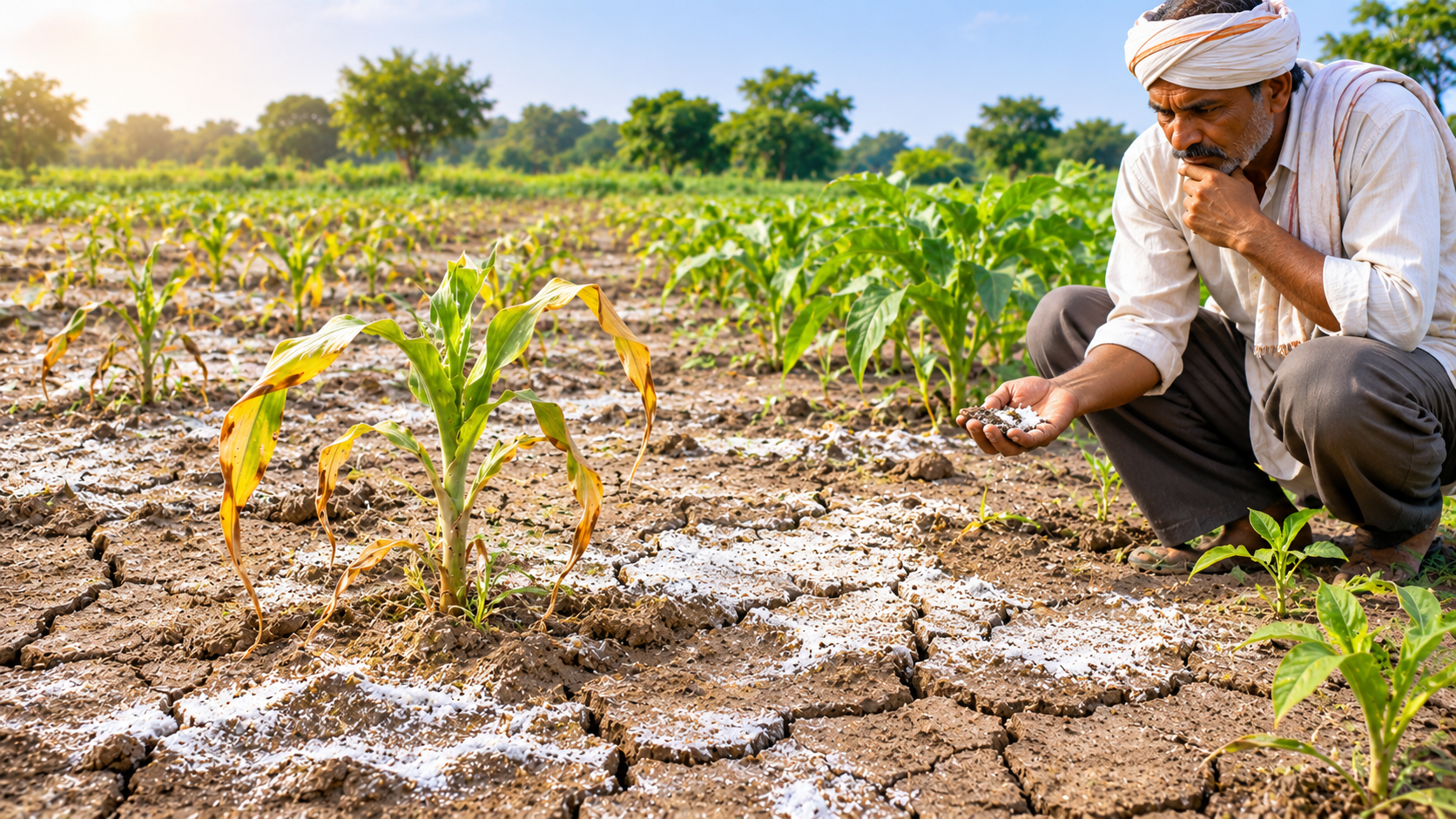
A field may look perfectly normal, receive adequate irrigation and even get the required fertilisers, yet its crops may continue to struggle. Seeds fail to germinate properly, plants remain stunted, leaves develop burnt edges and yields gradually decline. The reason may not be a shortage of nutrients or water. It could be something much less visible but equally damaging: soil salinity.
Soil salinity is one of the most overlooked challenges in agriculture. It develops gradually, often without attracting much attention until crop performance begins to deteriorate. What makes it particularly dangerous is that a farmer may continue investing in seeds, fertilisers, irrigation and crop protection without realising that excess salts in the soil are limiting the crop's ability to use available water and nutrients.
Understanding soil salinity is therefore not just a matter of soil science. It is essential for protecting agricultural land, maintaining crop productivity and ensuring long-term farming sustainability.
1. What Is Soil Salinity?
Soil salinity refers to the accumulation of excessive amounts of water-soluble salts in the soil. These salts generally include compounds of sodium, calcium, magnesium, chlorides, sulphates and bicarbonates.
All soils naturally contain some dissolved salts, and many of these elements are essential for plant growth. Problems arise when their concentration becomes excessive and starts interfering with normal plant functions.
When the concentration of soluble salts increases beyond the tolerance level of a particular crop, the soil becomes saline enough to restrict plant growth.
One important aspect of soil salinity is that it does not necessarily mean the soil has become completely unproductive. The severity of the problem depends on the concentration and composition of salts, soil characteristics, water availability, drainage conditions and the salt tolerance of the crop being cultivated.
In simple terms, soil salinity occurs when the salt concentration in the root zone becomes high enough to make it difficult for plants to absorb water and maintain healthy growth.
2. How Does Soil Salinity Develop?
Soil salinity rarely develops overnight. It is generally the result of continuous salt accumulation over time, particularly when salts enter the soil faster than they are removed.
Several agricultural and environmental factors contribute to this process.
Excessive or Improper Irrigation
Irrigation water naturally contains dissolved salts. Even water that appears clean may carry small quantities of dissolved minerals.
When irrigation is repeated over several cropping seasons, these salts can gradually accumulate in the soil. If sufficient drainage is unavailable, the salts remain within the root zone and their concentration increases.
Over-irrigation can make the situation worse, particularly where the soil has poor drainage and excess water cannot move away.
Use of Saline Irrigation Water
Farmers in water-scarce regions sometimes depend on groundwater containing elevated concentrations of dissolved salts.
Continuous use of such water introduces additional salts into agricultural land. Without proper monitoring and management, the soil gradually becomes less suitable for sensitive crops.
Poor Soil Drainage
Drainage plays a crucial role in maintaining soil health.
When excess irrigation or rainfall water cannot move through and out of the soil, dissolved salts remain behind. In areas with a high groundwater table, water may also move upwards through capillary action, bringing dissolved salts towards the soil surface.
As the water evaporates, the salts remain behind and accumulate.
High Evaporation and Low Rainfall
Hot and dry climatic conditions accelerate soil salinity.
When water evaporates from the soil surface, dissolved salts are left behind. In regions where rainfall is insufficient to wash these salts below the root zone, their concentration continues to increase.
This is particularly relevant in semi-arid and arid agricultural regions.
Excessive and Imbalanced Fertiliser Application
Fertilisers are essential for crop nutrition, but excessive or poorly managed application can increase the concentration of soluble salts around plant roots.
Repeated applications without considering soil test results, crop requirements and irrigation practices can contribute to increasing soil salinity.
Natural Geological Conditions
In certain regions, salts are naturally present in the underlying soil or parent material. Weathering, groundwater movement and natural mineral deposits can bring these salts into the agricultural root zone.
Therefore, soil salinity is not always caused by farming practices alone. Natural environmental conditions can also play a significant role.
3. Why Is Soil Salinity Called a Silent Threat?
The biggest challenge with soil salinity is that its early symptoms are often confused with other agricultural problems.
A farmer may assume that poor crop growth is caused by nutrient deficiency, insufficient irrigation, disease or inadequate fertiliser application.
However, the actual problem may be excessive salt concentration in the root zone.
In its early stages, soil salinity may not produce obvious white salt deposits on the soil surface. The damage can begin below the surface, where plant roots encounter unfavourable conditions.
As salinity increases, the effects become more visible:
Poor seed germination and uneven crop establishment.
Slow or stunted plant growth.
Reduced root development.
Yellowing of leaves and marginal leaf burn.
Wilting despite adequate moisture in the soil.
Reduced flowering and fruit formation.
Premature leaf ageing and drying.
Smaller fruits, grains or other harvested produce.
Declining crop yields over successive seasons.
The important point is that visible symptoms alone cannot confirm soil salinity. Similar symptoms can occur due to drought, nutrient deficiencies, waterlogging and other soil-related problems.
This is why proper soil and irrigation water testing is essential.
4. How Does Soil Salinity Affect Plant Growth?
To understand the seriousness of soil salinity, it is important to understand how plants absorb water and nutrients.
Excessive salts affect plants through three major mechanisms.
A. Osmotic Stress: Plants Cannot Absorb Water Easily
This is one of the most important effects of soil salinity.
Plants absorb water from the soil through their roots. However, when salt concentration in the soil solution becomes too high, the ability of roots to absorb water decreases.
In severe conditions, water may even move out of plant root cells.
As a result, plants experience physiological water stress even when the soil appears moist.
This explains why crops growing in saline soil may show wilting symptoms despite receiving adequate irrigation.
B. Specific Ion Toxicity
Certain ions, particularly sodium and chloride, can accumulate in plant tissues in excessive quantities.
When this happens, they may damage plant cells, interfere with metabolic activities and affect normal physiological functions.
Different crops have different levels of tolerance to these ions. Some crops are particularly sensitive, while others can tolerate comparatively higher concentrations.
C. Nutrient Imbalance
Excessive salts can interfere with the absorption and availability of essential nutrients.
For example, high sodium concentrations can interfere with potassium and calcium nutrition. Excessive chloride may affect nitrate uptake, while high concentrations of certain salts can create imbalances involving magnesium and other nutrients.
Consequently, plants may exhibit nutrient deficiency symptoms even when the soil contains adequate quantities of those nutrients.
This is an important reason why simply applying more fertiliser does not necessarily solve the problem.
5. Soil Salinity vs Soil Sodicity: Understanding the Difference
Soil salinity and soil sodicity are often used interchangeably, but they are not the same.
Understanding the difference is essential because their management requirements are different.
Soil Salinity
Saline soils contain excessive concentrations of soluble salts. Their primary effect is to make water absorption difficult for plants.
These soils may still have a reasonably good soil structure, depending on their chemical composition.
Soil Sodicity
Sodic soils contain excessive exchangeable sodium in relation to other positively charged ions such as calcium and magnesium.
High exchangeable sodium can cause soil particles to disperse, resulting in poor soil aggregation, surface crusting, reduced water infiltration and restricted air movement.
As a result, roots struggle to penetrate the soil, and water movement becomes difficult.
Can a Soil Be Both Saline and Sodic?
Yes. Some soils have both high soluble salt concentrations and excessive exchangeable sodium.
Such soils present a more complicated management challenge because farmers need to address both salt accumulation and the deterioration of soil structure.
This distinction is particularly important when selecting soil amendments. A treatment suitable for sodic soil may not be necessary or appropriate for every saline soil.
6. How Can Farmers Identify Soil Salinity?
Early identification is the most effective way to prevent soil salinity from becoming a serious agricultural problem.
Farmers should observe their fields carefully and look for the following indicators.
White Deposits on the Soil Surface
White or greyish salt deposits may appear on the soil surface, particularly in dry areas or around irrigation channels.
Although these deposits can indicate salt accumulation, their absence does not rule out salinity.
Uneven Crop Growth
If certain portions of a field consistently show poor germination, stunted plants or reduced growth compared with other areas, salinity may be one possible reason.
Such patches often appear repeatedly across cropping seasons.
Poor Water Infiltration
In sodic soils, excessive sodium can cause soil particles to disperse and reduce water infiltration.
Water may remain standing on the surface instead of entering the soil effectively.
Leaf Burning and Premature Drying
Salinity-sensitive crops may develop brown leaf margins, yellowing and premature drying.
These symptoms are especially noticeable during periods of high temperature and increased water demand.
Declining Productivity
A gradual reduction in crop performance despite following similar cultivation practices may indicate an underlying soil-related problem.
However, farmers should avoid diagnosing salinity based only on visual observations.
The most reliable approach is to conduct proper soil and irrigation water testing.
7. Understanding EC: The Most Important Indicator of Soil Salinity
Electrical Conductivity (EC) is one of the most widely used indicators for measuring soil salinity.
Dissolved salts increase the electrical conductivity of water. Therefore, measuring the conductivity of a soil-water extract provides an indication of the concentration of soluble salts.
Soil salinity is commonly evaluated using the electrical conductivity of a saturated soil paste extract, expressed as dS/m at 25°C.
As a general classification:
Below 2 dS/m: Generally non-saline for most agricultural purposes.
2–4 dS/m: Slightly saline.
4–8 dS/m: Moderately saline.
8–16 dS/m: Strongly saline.
Above 16 dS/m: Very strongly saline.
These categories are indicative, not universal crop-safety limits. Some sensitive crops can experience yield reductions at EC levels below 4 dS/m, while salt-tolerant crops can perform better at higher levels.
It is also important to distinguish between soil EC and irrigation water EC.
Soil EC measures salt concentration in the soil extract, whereas irrigation water EC indicates the concentration of dissolved salts in the water being applied.
The two measurements serve different purposes and should not be interpreted interchangeably.
Why Should Farmers Test Soil EC Regularly?
Regular EC testing helps farmers:
Identify increasing salt accumulation before severe damage occurs.
Evaluate the suitability of land for particular crops.
Monitor the quality of irrigation water.
Assess the effectiveness of soil reclamation practices.
Make better decisions regarding irrigation and fertiliser application.
For meaningful comparisons, soil samples should be collected from representative locations and depths, using consistent sampling and testing procedures.
8. Which Crops Are More Sensitive to Soil Salinity?
Not all crops respond to salinity in the same way.
Some crops experience significant yield reductions even under moderately saline conditions, while others can tolerate comparatively higher salt concentrations.
Among commonly cultivated crops, beans, chickpea and several vegetable crops can be relatively sensitive to salinity.
Crops such as wheat, cotton, barley and certain forage crops generally have comparatively better salt tolerance, although their performance still declines when salinity becomes excessive.
For vegetable cultivation, crops such as onion, carrot, beans and many leafy vegetables require particular attention to soil and irrigation water quality.
The selection of crops should therefore be based on local soil conditions, irrigation water quality, climatic conditions and the expected level of salinity.
An important consideration is that salt tolerance is not constant throughout the crop life cycle. Many crops are particularly sensitive during germination and early seedling establishment.
Therefore, a crop that can tolerate moderate salinity during its later growth stages may still experience poor establishment when exposed to the same conditions during germination.
9. How to Prevent Soil Salinity Before It Becomes a Serious Problem
Prevention is generally more economical and practical than reclaiming severely salt-affected agricultural land.
Farmers should adopt a combination of irrigation management, drainage improvement, soil monitoring and balanced nutrient application.
A. Test Irrigation Water Before Regular Use
Water quality should never be judged only by its appearance.
Farmers should periodically test irrigation water for electrical conductivity, pH, sodium adsorption ratio (SAR), bicarbonates, chlorides and other relevant parameters.
This helps identify whether the water is introducing excessive salts into the soil.
Where water quality is unsuitable, farmers should seek technical advice on blending, treatment or alternative water sources.
B. Avoid Excessive Irrigation
Applying more water than the crop requires does not automatically improve crop growth.
Excessive irrigation can raise the groundwater table, contribute to waterlogging and increase the risk of salt accumulation, particularly in poorly drained fields.
Irrigation should be scheduled according to crop requirements, soil moisture, weather conditions and the water-holding capacity of the soil.
C. Maintain Proper Drainage
Good drainage is essential for managing salt-affected soils.
Where drainage conditions permit, excess water can move through the soil and carry dissolved salts below the root zone.
However, drainage water must have a safe disposal route. Simply moving saline water from one field to another does not solve the problem.
D. Adopt Drip Irrigation Where Suitable
Drip irrigation can help manage water application more efficiently by delivering water close to the root zone.
It can also help maintain a favourable moisture zone around roots when properly designed and managed.
However, drip irrigation does not eliminate salinity. Salts can accumulate near the outer edges of the wetted zone, and periodic management may be necessary to prevent them from moving back towards active roots.
E. Apply Fertilisers Based on Soil Testing
Farmers should avoid unnecessary or excessive fertiliser application.
Nutrient requirements should be determined according to soil test results, crop requirements and the existing nutrient status of the field.
Balanced fertilisation reduces the risk of unnecessary salt loading and helps maintain efficient nutrient use.
10. Practical Methods to Manage and Reclaim Saline Soil
Once soil salinity has been identified, the next step is to determine its severity and select an appropriate management strategy.
The objective is not simply to reduce the visible salt deposits but to bring salt concentrations within a range that supports healthy crop growth.
A. Leaching of Excess Salts
Leaching is one of the most effective methods for managing saline soils.
It involves applying suitable-quality water in a controlled manner so that dissolved salts move below the crop root zone.
However, leaching should only be undertaken when adequate drainage is available.
Without proper drainage, the salts may simply move within the soil profile or contribute to a rising groundwater table.
The quantity and timing of water required depend on soil texture, initial salinity, water quality, drainage and the depth of the root zone.
B. Application of Gypsum Where Required
Gypsum is commonly used for reclaiming sodic soils.
It supplies calcium, which helps replace excessive exchangeable sodium from soil particles. The displaced sodium can then be removed through appropriate irrigation and drainage.
However, gypsum is not a universal treatment for all saline soils.
Its application should be based on soil analysis, particularly exchangeable sodium percentage (ESP), cation exchange capacity (CEC) and the calculated gypsum requirement.
Applying gypsum without understanding the actual soil condition can result in unnecessary expenditure and limited benefits.
C. Incorporating Organic Matter
Adding suitable organic materials such as well-decomposed farmyard manure, compost and crop residues can support soil health.
Organic matter can improve soil aggregation, support beneficial soil organisms, increase water-holding capacity in suitable soils and improve nutrient cycling.
In sodic and structurally degraded soils, organic matter can also support the recovery of soil structure when combined with appropriate amendments and drainage management.
However, organic matter alone cannot remove large quantities of accumulated soluble salts.
Farmers should also ensure that the compost or manure being applied is of good quality and does not contain excessive soluble salts.
D. Growing Salt-Tolerant Crops
During the reclamation or management phase, selecting relatively salt-tolerant crops can help maintain agricultural production.
Depending on local conditions, crops such as barley, cotton, wheat and certain salt-tolerant forage varieties may be considered.
Crop selection should be based on actual soil EC, water quality and local agronomic recommendations rather than general assumptions.
E. Using Green Manuring and Suitable Cover Crops
Green manuring can help improve soil organic matter, biological activity and soil structure.
Suitable cover crops can also protect the soil surface, reduce erosion and improve the overall condition of agricultural land.
The species selected should be appropriate for the salinity level and local climate. Their ability to survive under saline conditions should be evaluated before large-scale cultivation.
F. Practising Crop Rotation
Continuous cultivation of the same crop can place repeated demands on specific nutrients and may not be suitable for salt-affected fields.
A well-planned crop rotation involving suitable crops can improve nutrient management, maintain soil cover and reduce the risks associated with continuous monocropping.
However, crop rotation should complement, not replace, the necessary measures for controlling salt accumulation.
11. The Role of Soil Biology in Managing Salt-Affected Land
Healthy soil is not simply a mixture of minerals, water and organic matter. It is a living system containing bacteria, fungi, earthworms and numerous other organisms that contribute to soil functioning.
Salinity can disturb this biological balance.
High salt concentrations may reduce the activity and diversity of beneficial soil organisms, affect organic matter decomposition and interfere with nutrient cycling.
This can gradually weaken the natural functioning of the soil ecosystem.
Maintaining organic matter, reducing unnecessary chemical loading, avoiding excessive soil disturbance and maintaining suitable moisture conditions can help support a healthier soil environment.
Certain naturally occurring plant-associated organisms and soil organisms are also being studied for their ability to support plant growth under salt stress.
However, their effectiveness depends on the organism, crop, soil conditions and environmental factors. They should be viewed as potential supportive tools rather than substitutes for proper salinity management.
The long-term objective should be to restore a balanced soil environment in which physical, chemical and biological processes function together.
12. How Soil Salinity Affects Agricultural Economics
Soil salinity is not just an agronomic problem. It is also an economic challenge for farmers.
When salt concentration increases, crop productivity may decline even if farmers continue investing the same amount in agricultural inputs.
This creates a situation in which cultivation costs remain high while returns gradually decrease.
The economic consequences include:
Increased Irrigation Costs: Farmers may need additional water and more frequent irrigation management to maintain suitable moisture conditions.
Higher Soil Amendment Expenses: Depending on the severity of the problem, farmers may need to invest in gypsum, drainage systems, organic amendments and other corrective measures.
Reduced Fertiliser Efficiency: Even when nutrients are present in the soil, salinity can interfere with their absorption and utilisation by plants.
Lower Crop Yield: Reduced germination, stunted growth and poor reproductive development can directly affect the quantity of harvested produce.
Declining Produce Quality: Salinity-related stress can affect crop size, appearance, uniformity and marketable yield, depending on the crop and severity of exposure.
Reduced Land Productivity: If left unmanaged for several years, salt accumulation and associated soil degradation can make agricultural land increasingly difficult and expensive to cultivate.
Therefore, identifying soil salinity at an early stage can help farmers avoid unnecessary expenditure and protect their long-term agricultural investment.
13. Common Mistakes Farmers Should Avoid
Even when farmers are aware of soil salinity, certain practices can unintentionally make the situation worse.
Some of the most common mistakes include:
Applying additional fertilisers without conducting soil tests.
Increasing irrigation without understanding the drainage conditions.
Using groundwater continuously without checking its salt concentration.
Applying gypsum to every salt-affected field without determining whether the problem is salinity or sodicity.
Ignoring early symptoms of poor germination and uneven crop growth.
Assuming that white deposits are the only indication of soil salinity.
Using organic manure without checking its quality and salt content.
Growing salt-sensitive crops in fields with known salinity problems.
Ignoring groundwater levels in areas with poor drainage.
Treating the symptoms without addressing the actual source of salt accumulation.
The most important lesson is that soil salinity requires diagnosis before treatment.
A scientifically planned approach is always more effective than relying on guesswork or applying corrective materials without understanding the underlying problem.
14. A Practical Action Plan for Farmers
Farmers who suspect soil salinity in their fields can follow a systematic approach.
Step 1: Observe the Field
Identify areas showing poor germination, uneven plant growth, leaf burning, wilting or visible salt deposits.
Mark these locations for further investigation.
Step 2: Conduct Soil Testing
Collect representative soil samples and test electrical conductivity, pH and other relevant parameters.
Where sodicity is suspected, also assess ESP, CEC and other appropriate soil chemical properties.
Step 3: Test Irrigation Water
Evaluate the quality of the water being used for irrigation. Check EC, SAR, pH and other relevant parameters.
Step 4: Identify the Actual Problem
Determine whether the field is saline, sodic, saline-sodic or affected by another soil-related issue.
This distinction will determine the corrective measures required.
Step 5: Improve Irrigation and Drainage
Prepare an irrigation and drainage management plan according to soil conditions, water availability and crop requirements.
Step 6: Select Suitable Soil Amendments
Use gypsum or other amendments only where recommended by soil analysis and technical assessment.
Incorporate good-quality organic matter where appropriate.
Step 7: Select Suitable Crops
Choose crops and varieties according to the actual salinity level and their tolerance.
Step 8: Monitor Progress
Repeat soil and water testing at suitable intervals and compare the results.
Monitor crop establishment, plant growth and yield to evaluate whether the management practices are working.
This approach helps farmers move from reactive treatment to preventive and scientifically managed agriculture.
15. The Future of Agriculture Depends on Healthy Soil
Agricultural productivity is often discussed in terms of better seeds, advanced machinery, improved fertilisers and modern irrigation systems.
However, none of these investments can deliver their full potential if the soil itself is deteriorating.
Soil salinity reminds us that agricultural productivity depends not only on what farmers add to the soil but also on the condition of the soil in which crops grow.
As climate patterns change, water availability becomes increasingly uncertain and groundwater quality varies across regions, managing soil salinity will become even more important.
Farmers, agricultural experts and policymakers must work together to encourage regular soil testing, responsible irrigation, effective drainage and sustainable soil management practices.
The emphasis should shift from simply increasing crop production in the short term to preserving the productive capacity of agricultural land over the long term.
A healthy soil ecosystem is one of the most valuable assets a farmer can possess. Protecting it requires continuous observation, informed decisions and responsible farming practices.
Protect the Soil Before the Soil Stops Supporting Your Crops
Soil salinity is a gradual problem, but its consequences can be significant.
It affects the ability of plants to absorb water, interferes with nutrient uptake, restricts root development and ultimately reduces agricultural productivity.
The good news is that many salt-affected soils can be managed, and in suitable conditions, their productivity can be restored through scientifically planned interventions.
The first step is awareness. The second is accurate diagnosis. The third is taking timely corrective action.
Farmers should remember that a productive field is not necessarily one that receives the maximum quantity of water or fertiliser. It is one in which water, nutrients, soil structure and biological activity remain in balance.
Healthy soil produces healthy crops. Protecting soil health today is an investment in the productivity of tomorrow.
#SoilSalinity #SoilHealth #SoilManagement #SustainableAgriculture #SoilConservation #Agriculture #SmartFarming #SoilTesting #CropProductivity #SalinityManagement #WaterManagement #SoilFertility #FarmerAwareness #RegenerativeAgriculture #SustainableFarming #AgriculturalProductivity #HealthySoilHealthyCrops #IndianAgriculture