

Mosaic, Curl and Stunting: Know Your Virus
Learn to Recognize Viral Disease Before It Spreads Across the Field
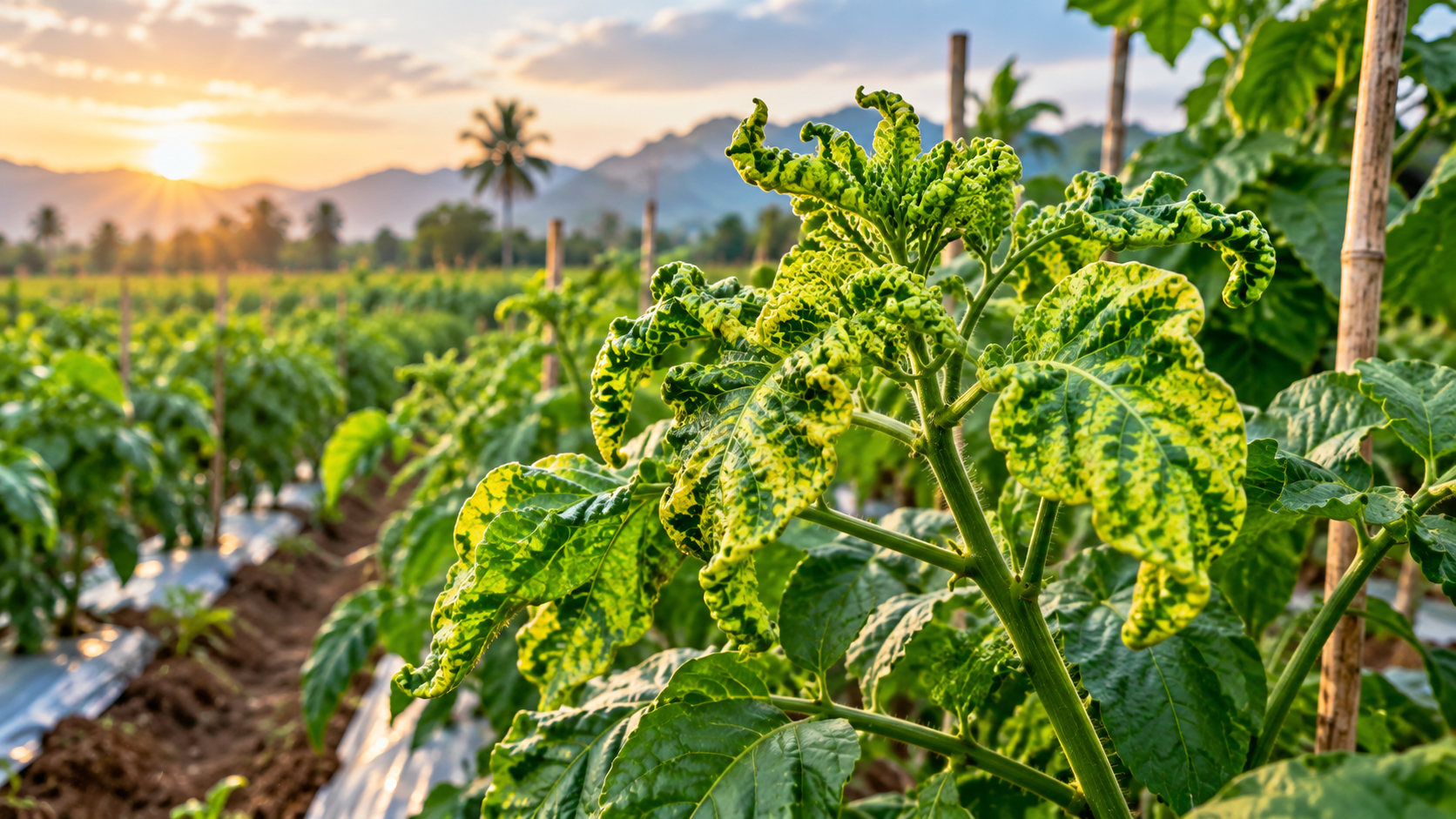
A plant can look green, alive and reasonably healthy while a virus is already moving through its tissues. Then the symptoms appear, mosaic leaves, curling, distortion, unusual coloration or stunted growth. By that stage, the real challenge is not simply treating the affected plant; it is stopping the virus from reaching the next one.
What Exactly Is a Plant Virus?
Plant viruses are extremely small infectious agents that can multiply only inside living cells.
Unlike fungi and bacteria, viruses do not grow independently on plant surfaces or in the soil in the same way those organisms do. They depend on living host cells to reproduce.
Once a virus enters a susceptible plant, it can use the plant's cellular machinery to produce more viral material. The infection can then move from cell to cell and, for many viruses, throughout the plant.
Different viruses affect different crops and can produce very different symptoms.
Some cause dramatic leaf patterns. Others primarily affect plant growth, fruit development, flowers, roots or the overall productivity of the plant.
The most important point for farmers is this:
A viral disease is an infection and not simply a deficiency or a cosmetic leaf problem.
Why Viral Diseases Are Different From Fungal and Bacterial Diseases
Understanding this difference is essential for making the right crop-protection decision.
Fungi are living organisms that can grow and reproduce through structures such as spores and fungal hyphae.
Bacteria are microscopic single-celled organisms that can multiply on or inside suitable plant tissues.
Viruses are fundamentally different. They depend on living host cells for replication.
This difference has a major practical consequence:
Once a plant is systemically infected by a virus, there is generally no conventional field treatment that can simply eliminate the virus and return the plant to its original healthy condition.
Therefore, viral disease management focuses heavily on prevention, early detection, vector management, healthy planting material and stopping further spread.
The Classic Warning Sign: Mosaic Patterns
One of the most recognizable symptoms of plant viral infection is a mosaic pattern.
Instead of having a uniform green color, the leaf develops irregular areas of:
- Light green
- Dark green
- Yellow-green
- Yellow
- Sometimes almost white
The pattern may appear as patches, streaks, bands or irregular mottling.
Mosaic symptoms can be striking, but they are not exclusive to viruses.
Nutritional disorders, herbicide injury and other stresses can sometimes create similar color patterns.
Therefore:
Mosaic = a warning sign, not an automatic diagnosis.
Leaf Curling and Distortion
Another common viral symptom is abnormal leaf shape.
Young leaves may become:
- Curled
- Twisted
- Narrow
- Thickened
- Crinkled
- Distorted
- Smaller than normal
The growing point may also become abnormal.
In crops such as chilli, tomato and other vegetables, severe viral infections can produce dramatic changes in young foliage and overall plant architecture.
A particularly important clue is when new growth is much more distorted than older leaves.
However, leaf curling can also result from insect feeding, herbicide injury, environmental stress and other causes.
Diagnosis therefore requires looking beyond the curl itself.
Vein Clearing and Vein Discoloration
Some plant viruses produce changes along leaf veins.
Veins may become unusually pale or translucent, a symptom commonly referred to as vein clearing.
In other cases, veins may become more prominent, yellow or otherwise discolored.
These changes can occur before more obvious mosaic or distortion develops.
When inspecting suspicious plants, therefore, do not look only at the broad surface of the leaf.
Look closely at the veins and the tissue surrounding them.
Stunted Growth
A viral infection can interfere with normal plant development.
Affected plants may remain noticeably smaller than healthy plants of the same age.
You may observe:
- Shorter plants
- Smaller leaves
- Shorter internodes
- Reduced branching
- Poor canopy development
- Delayed flowering
- Reduced fruit formation
- Smaller fruits
- Overall weak growth
When viral infection occurs early in the crop cycle, the impact can be particularly significant because the plant has a longer period during which its growth and productivity can be affected.
Why Early Infection Can Be So Serious
Consider two plants.
One becomes infected very early after planting.
Another becomes infected close to harvest.
The first plant may experience a much longer period of disrupted growth and development.
It may produce fewer branches, fewer flowers and fewer marketable fruits.
This is why controlling the source and spread of viruses early in the crop cycle is so important.
Viral Diseases Can Affect Fruits Too
Viral symptoms are not limited to leaves.
Depending on the crop and virus, infection may affect fruit development and quality.
Fruits may become:
- Distorted
- Smaller than normal
- Unevenly colored
- Mottled
- Ringed
- Streaked
- Misshapen
In some crops, the external appearance may become commercially unacceptable even when the plant remains alive.
This is particularly important for vegetables and fruits where market value depends heavily on appearance, uniformity and size.
Rings, Streaks and Unusual Patterns
Some viral infections create distinctive patterns such as:
- Ringspots
- Concentric rings
- Veinal streaks
- Stripes
- Mottling
- Blotches
- Feathering
- Color breaks
These patterns can sometimes provide useful clues about the type of viral disease involved.
However, individual symptoms should never be used as a stand-alone diagnosis.
The crop, variety, age of the plant, symptom distribution and presence of insect vectors all matter.
How Do Plant Viruses Spread?
This is perhaps the most important practical question.
A virus cannot simply move across a field on its own like dust.
It needs a route of transmission.
Major routes include:
Insect vectors
Infected planting material
Mechanical transmission
Seed
Grafting and propagation
Contaminated tools and hands
Contact between plants in certain situations
The importance of each route depends on the specific virus.
Insects: The Major Highway for Many Plant Viruses
Many economically important plant viruses are transmitted by insects.
Important vector groups include:
- Aphids
- Whiteflies
- Thrips
- Leafhoppers
- Some beetles
- Other sap-feeding insects
These insects feed on plants and can acquire viruses from infected plants and subsequently transmit them to healthy plants.
This creates a dangerous cycle:
Infected plant → insect acquires virus → insect moves → healthy plant becomes infected.
Once the vector population increases, the disease can spread rapidly.
This is why viral disease management and vector management are closely connected.
Why You Should Not Wait Until You See Thousands of Insects
By the time a farmer notices a large insect population, virus transmission may already have occurred.
Some insect vectors are tiny and difficult to notice.
Others may move rapidly between plants.
Therefore, effective management requires regular monitoring of vector populations rather than waiting for a visible outbreak.
Inspect the underside of leaves and young growth, where many sap-feeding insects prefer to feed.
Look for:
- Whiteflies
- Aphids
- Thrips
- Leafhoppers
- Nymphs
- Eggs
- Honeydew
- Insect feeding damage
The presence of a vector does not automatically mean a virus is present, but it increases the importance of careful monitoring when viral symptoms are also appearing.
The Problem With "Just Kill the Insect"
Vector control is important, but it is not always enough.
Some insects can acquire and transmit a virus very quickly.
In certain virus-vector relationships, transmission can occur before an insect is exposed to an insecticide long enough for the insecticide to kill it.
This means that viral disease management cannot rely on insecticides alone.
The broader strategy should include:
Healthy planting material + vector monitoring + weed management + sanitation + removal of infected plants where appropriate + crop management.
Infected Planting Material Can Carry Viruses
A plant can look acceptable and still carry a virus.
This is particularly important for vegetatively propagated crops.
Infected:
- Cuttings
- Grafts
- Seedlings
- Tubers
- Bulbs
- Other planting material
can introduce viruses into a new production area.
Once the infected material is planted, it can become a source from which vectors or mechanical operations spread the virus further.
Healthy planting material is therefore one of the most important foundations of viral disease prevention.
Seeds Can Also Be Important
Some plant viruses can be transmitted through seed, although this varies greatly among virus-host combinations.
This means that seed health can matter when a particular viral disease is known to be seed-transmitted.
Farmers dealing with recurring viral problems should consider the source and health status of seed rather than assuming that the problem begins only after planting.
Mechanical Transmission: Your Hands and Tools Can Matter
Not every virus requires an insect.
Some viruses can move mechanically from an infected plant to a healthy plant.
This can happen through:
- Hands
- Cutting tools
- Pruning equipment
- Grafting tools
- Harvesting operations
- Plant-to-plant contact
- Handling of infected plant material
The risk depends strongly on the virus.
For crops and viruses known to be mechanically transmissible, hygiene during pruning, grafting and other operations becomes especially important.
Why Weeds Matter in Viral Disease Management
Weeds are not merely competitors for water and nutrients.
Some weeds can act as alternative hosts or reservoirs for plant viruses and their vectors.
An infected weed can potentially maintain a virus in or around a field even when the main crop is absent or between production cycles.
If vectors are present, these plants may contribute to the continuation of the disease cycle.
Therefore, weed management can form an important part of integrated viral disease management.
A Virus Can Be Present Before Symptoms Become Obvious
This is one of the most important things to understand about viral disease.
There can be a period between infection and visible symptom development.
During that period, a plant may appear normal while the virus is already replicating and moving within the plant.
Consequently, removing only plants that show severe symptoms may not always eliminate the problem.
The earlier the disease and its transmission pathways are recognized, the more opportunities there are to reduce further spread.
Why Some Plants Look Different From Others
Not every infected plant necessarily shows the same severity of symptoms.
The expression of viral disease can depend on:
- Plant age at infection
- Variety
- Virus strain
- Environmental conditions
- Plant nutrition
- Vector pressure
- Co-infection with other pathogens
- Overall plant health
One plant may show severe mosaic and distortion while another may show relatively mild symptoms.
This variation can make field diagnosis difficult.
Mild Symptoms Do Not Always Mean a Minor Problem
A plant with mild symptoms may still have reduced productivity.
Similarly, a plant that appears nearly normal may still potentially serve as a source of infection, depending on the virus and transmission pathway.
Therefore, farmers should not judge the importance of a viral disease solely by the visual severity of one plant.
Look at the whole field pattern and disease progression.
How to Scout for Viral Disease
Viral disease scouting should be systematic.
Walk through the crop rather than inspecting only the plants near the field entrance.
Look at different sections of the field.
Pay particular attention to:
- Field edges
- Areas near weeds
- Areas with high insect activity
- New plantings
- Older plantings
- Protected-cultivation entry points
- Areas with abnormal plant growth
Look for clusters of plants showing similar symptoms.
Then compare affected plants with apparently healthy plants of the same age and variety.
What Should You Look For?
Examine young leaves carefully.
Look for:
Mosaic patterns
Mottling
Leaf curling
Leaf narrowing
Vein clearing
Vein discoloration
Crinkling
Distortion
Stunting
Unusual branching
Fruit deformation
Abnormal coloration
Then look for potential vectors.
If both virus-like symptoms and vector activity are present, the need for careful diagnosis becomes even more important.
Do Not Confuse Viral Symptoms With Nutrient Deficiency
This is one of the most common sources of confusion.
Yellowing or mottling can result from nutrient deficiency.
But viral infections can also produce yellow-green patterns.
The difference may become clearer when you examine:
- Whether symptoms are symmetrical
- Which leaves are affected first
- Whether veins are involved
- Whether leaves are distorted
- Whether growth is stunted
- Whether insects are present
- Whether symptoms are appearing in clusters
- Whether the problem is spreading over time
A nutrient deficiency often follows a different pattern from an infectious disease.
But visual diagnosis alone may still be insufficient.
Do Not Confuse Virus With Herbicide Injury
Herbicide injury can produce:
- Leaf curling
- Twisting
- Narrow leaves
- Distorted growing points
- Stunting
- Abnormal coloration
These can look remarkably similar to viral symptoms.
Before concluding that a crop has a virus, review recent herbicide applications and possible drift from neighboring fields.
Ask:
Was a herbicide recently applied?
Could spray drift have reached the crop?
Did symptoms appear simultaneously across a large area?
Are symptoms concentrated on the side facing the neighboring field?
These clues can help distinguish an infectious disease from chemical injury.
The Importance of Field Pattern
Field distribution can be extremely informative.
Suppose viral symptoms begin near the edge of a field and gradually appear farther inward.
That may suggest a vector entering from outside.
Suppose symptoms appear in scattered individual plants.
That may indicate another pattern of introduction or transmission.
Suppose symptoms occur in a uniform area after a chemical application.
An abiotic cause may need to be considered.
The pattern of disease is often as important as the symptom itself.
What Happens to an Infected Plant?
Once a susceptible plant becomes systemically infected, the virus may move beyond the original infection site.
Depending on the virus and host, infection can spread through plant tissues and reach growing points and other organs.
This is why removing or isolating an infected plant may be considered in some production systems.
The objective is not necessarily to "cure" the plant.
The objective is to reduce it as a potential source of further infection.
Should Virus-Affected Plants Be Removed?
In some crops and viral diseases, removing severely infected plants—often called roguing—can help reduce sources of infection.
But roguing must be done thoughtfully.
If infected plants are handled carelessly, the operation itself can potentially spread a mechanically transmissible virus.
When roguing is recommended:
- Remove plants carefully.
- Avoid unnecessary contact with neighboring healthy plants.
- Follow appropriate sanitation procedures.
- Manage removed plant material properly.
- Pay attention to vectors that may already be present.
Roguing is a management tool, not a universal cure.
Can a Virus-Infected Plant Be Cured?
This is where farmers need a clear distinction.
For most field situations, once a plant is systemically infected with a plant virus, there is no conventional field spray that reliably eliminates the virus from the entire plant and restores it to its original healthy state.
Some products may help support plant vigor or reduce secondary stress, but they should not be presented as guaranteed cures for an established viral infection.
This distinction is extremely important because it prevents farmers from repeatedly spending money on products while the actual source of infection continues to spread.
Then What Is the Right Strategy?
The focus should shift from:
"How do I kill the virus inside this plant?"
to:
"How do I prevent this virus from reaching the next plant?"
That change in thinking is the foundation of viral disease management.
Integrated Viral Disease Management
A strong management program combines several approaches.
Start Healthy
Use healthy seed and planting material from reliable sources.
Monitor Vectors
Regularly inspect the crop for aphids, whiteflies, thrips, leafhoppers and other relevant vectors.
Manage Weeds
Reduce potential alternative hosts and breeding sites for vectors where appropriate.
Scout Early
Identify suspicious plants before the disease becomes widespread.
Remove Sources Where Appropriate
Rogue infected plants when recommended for the particular crop and virus.
Maintain Hygiene
Clean tools and manage crop operations carefully when mechanical transmission is possible.
Use Suitable Varieties
Where resistant or tolerant varieties are available, incorporate them into the production strategy.
Manage Crop Health
Maintain balanced irrigation and nutrition so the crop can maintain strong growth and productivity.
This layered approach is much more reliable than depending on a single spray.
The Role of Insect Management
Because many plant viruses are transmitted by insects, vector management deserves special attention.
But effective vector management is more than simply spraying an insecticide.
An integrated approach can include:
- Regular scouting
- Sticky traps where appropriate
- Removal of heavily infested plant material
- Weed management
- Physical barriers where suitable
- Reflective or exclusion strategies in appropriate production systems
- Conservation of beneficial insects
- Appropriate insecticide use when necessary
- Rotation of insecticide modes of action to manage resistance
The exact strategy should depend on the crop, vector and production system.
Don't Destroy Every Insect You See
Not every insect is a virus vector.
Many insects are harmless or beneficial.
Some are predators or parasitoids that help control pest populations.
Therefore, indiscriminate insecticide use can disrupt beneficial organisms without necessarily solving the viral disease problem.
The objective is not "zero insects."
The objective is effective management of the insects that actually contribute to the disease or crop damage.
Resistant Varieties: One of the Strongest Tools
Where available, resistant or tolerant varieties can provide valuable protection against specific viral diseases.
Resistance does not necessarily mean the plant will never show symptoms under every possible condition.
But a suitable resistant variety can significantly reduce disease development or its impact.
Farmers should therefore consider the known viral disease history of their area when selecting varieties.
The Importance of Nursery Management
For crops transplanted from nurseries, viral disease management must begin before plants reach the field.
A nursery containing infected seedlings can distribute the problem across an entire farm.
Good nursery practices include:
- Starting with healthy seed
- Monitoring young plants frequently
- Controlling relevant insect vectors
- Removing suspicious plants appropriately
- Avoiding unnecessary plant handling
- Keeping nursery areas clean
- Separating new and older plant material where practical
A healthy nursery is an important first line of defense.
Protected Cultivation Requires Extra Vigilance
Greenhouses and shade-net structures can provide favorable growing conditions, but they can also create disease-management challenges.
Once a vector enters a protected structure, it may move among a large number of closely spaced plants.
Regular inspection of:
- Entry points
- Insect screens
- Young leaves
- Nursery plants
- Weed growth
- Crop residues
can help detect problems early.
In protected cultivation, prevention is particularly valuable because disease can spread quickly within a concentrated crop population.
Can Biological Products Help With Viral Problems?
This requires careful explanation.
Biological products and beneficial microorganisms may have roles in supporting plant health, influencing plant defense responses or managing insect vectors, depending on the product and application.
However, they should not be represented as guaranteed cures for an established viral infection.
The most scientifically sensible approach is to use biological tools as part of an integrated crop-health and disease-management program, where appropriate.
A healthy root zone and balanced crop management can support plant performance, but they do not mean that an established viral infection has been eliminated.
Why "Virus Cure" Claims Need Caution
Farmers encountering a viral disease may be tempted by products advertised as instant virus cures.
Be cautious.
A product that makes leaves appear greener or improves plant vigor does not necessarily mean the virus has been eliminated.
Similarly, the disappearance of one symptom does not automatically prove that the plant is virus-free.
The correct question is:
Has the virus actually been diagnosed, and is there evidence that the proposed intervention prevents or reduces its transmission or impact?
This distinction can save farmers considerable expense.
What About Nutrition During Viral Infection?
Balanced nutrition remains important for maintaining crop growth.
A plant under viral stress may require careful management of water and nutrients to maintain its remaining productive capacity.
But nutrition should not be confused with virus elimination.
Applying additional fertilizer simply because a plant looks weak can sometimes create excessive vegetative growth without solving the underlying problem.
Nutrition should therefore be based on actual crop requirements and, where appropriate, soil or plant testing.
A Practical Viral Disease Management Routine
Step 1: Scout
Inspect the crop regularly.
Step 2: Identify Suspicious Symptoms
Look for mosaic, curling, distortion, vein changes, stunting and unusual fruit patterns.
Step 3: Look for Vectors
Check for aphids, whiteflies, thrips, leafhoppers and other relevant insects.
Step 4: Examine the Pattern
Determine whether symptoms are scattered, clustered, edge-associated or associated with particular crop areas.
Step 5: Check Alternative Causes
Consider nutrient deficiency, herbicide injury, environmental stress and other pathogens.
Step 6: Confirm the Diagnosis
When the symptoms are unclear or economically important, seek expert or laboratory diagnosis.
Step 7: Reduce Sources of Infection
Where recommended, remove infected plants and manage weeds or infected planting material.
Step 8: Manage Transmission
Control relevant vectors and avoid unnecessary mechanical spread.
Step 9: Protect the Next Crop
Review planting material, variety selection, nursery hygiene and field sanitation before the next crop cycle.
The 8 Questions to Ask Before Treating a Suspected Viral Disease
1. Are the symptoms actually consistent with a virus?
2. Could nutrient deficiency, herbicide injury, insects, fungi or bacteria produce similar symptoms?
3. Are mosaic, curling, distortion, vein changes or stunting present?
4. Are known virus vectors present in the crop?
5. Did the problem begin in the nursery, field edge or a particular section?
6. Could infected seedlings, seed, cuttings or other planting material have introduced the disease?
7. Is the virus known to spread mechanically through crop operations?
8. What can be done now to prevent the infection from reaching additional plants?
These questions shift disease management from guesswork toward a structured approach.
The Most Important Lesson About Viral Disease
With fungal and bacterial diseases, farmers often think in terms of killing the pathogen.
With viruses, the more useful mindset is:
Prevent introduction. Prevent transmission. Reduce sources. Protect healthy plants.
Once a plant becomes systemically infected, the priority is often no longer to rescue that individual plant at any cost.
The priority becomes protecting the healthy population around it.
That is a very different way of thinking about crop protection.
Viruses Are Not the Same as Insects
This distinction is particularly important.
A farmer may see whiteflies on a plant and conclude:
"The whitefly is the disease."
It is not.
The insect may be a vector—a carrier capable of transmitting a virus.
Similarly, killing insects after widespread transmission has already occurred may not reverse infections that are already established.
Therefore, vector management must be combined with early scouting, healthy planting material and other preventive measures.
A Healthy Crop Is the First Line of Defense
Good crop management cannot make a susceptible plant completely immune to every virus.
But strong production practices can reduce unnecessary stress and improve the crop's ability to maintain growth.
That means:
Healthy planting material.
Balanced nutrition.
Appropriate irrigation.
Good field sanitation.
Effective weed management.
Regular pest monitoring.
Suitable varieties.
Good nursery management.
Early disease detection.
These practices form the foundation of viral disease management.
Don't Wait for the Virus to Announce Itself
Viral diseases can be difficult because the virus itself is invisible to the farmer.
What you see are its effects:
Mosaic.
Curling.
Distortion.
Vein clearing.
Stunting.
Rings and streaks.
Poor fruit development.
By the time these symptoms become obvious, infection may already have occurred.
That is why successful viral disease management begins much earlier—with healthy planting material, vector monitoring, field hygiene, weed management and regular crop scouting.
When symptoms appear, the first question should not be:
"Which spray will cure this?"
It should be:
"Is this really a virus, how is it spreading, and what can I do now to protect the healthy plants?"
That change in thinking can make the difference between treating symptoms and actually managing the disease.
Know the virus. Recognize the signs. Stop the spread. Protect the healthy crop.
#KnowYourVirus #PlantVirus #ViralDisease #PlantDisease #CropProtection #VirusManagement #PlantPathology #CropHealth #SmartFarming #FarmersEducation #HealthyCrops #IntegratedDiseaseManagement #VirusPrevention #SustainableAgriculture #AgriKnowledge #DiseaseManagement #HealthyFarming #BetterHarvest