


How NPK Deficiencies Secretly Destroy Plant Roots
The Unseen Crisis Under Every Weak Plant
A plant rarely collapses from the top first. The real damage usually begins underground.
While farmers and gardeners often focus on leaves, flowers, and fruits, the root system silently determines the plant’s strength, nutrient uptake, disease resistance, drought tolerance, and final yield. When Nitrogen (N), Phosphorus (P), or Potassium (K) become deficient, the roots are among the first organs to suffer. The result is not just slower growth, it is a complete weakening of the plant’s biological foundation.
A healthy root system acts like an underground highway network, continuously absorbing water, minerals, oxygen, and microbial support from the soil. But when NPK balance is disturbed, roots become thin, weak, poorly branched, brittle, discolored, and inefficient. Over time, the entire plant loses vigor even if external symptoms appear mild initially.
Balanced NPK nutrition is not simply about faster growth. It is about building a resilient underground architecture capable of supporting the plant through stress, pests, drought, salinity, and fluctuating weather conditions.
Why NPK Matters So Much for Root Development
Nitrogen, phosphorus, and potassium are known as primary macronutrients because plants require them in the highest quantities throughout their life cycle. Each one performs a distinct but interconnected role in root physiology.
Nitrogen drives vegetative development, protein formation, chlorophyll synthesis, and cellular expansion. Without enough nitrogen, roots fail to achieve sufficient mass and density.
Phosphorus is the energy nutrient. It powers ATP production, root initiation, cell division, and branching. Strong root establishment during early growth heavily depends on phosphorus availability.
Potassium regulates water balance, enzyme activation, stress resistance, and tissue strength. It maintains root integrity and helps roots tolerate environmental pressure.
When even one of these nutrients becomes unavailable, root growth patterns immediately begin to change.
Nitrogen Deficiency: The Silent Cause of Weak and Sparse Roots
Nitrogen deficiency is often associated with pale leaves and poor vegetative growth, but its underground effects are equally severe.
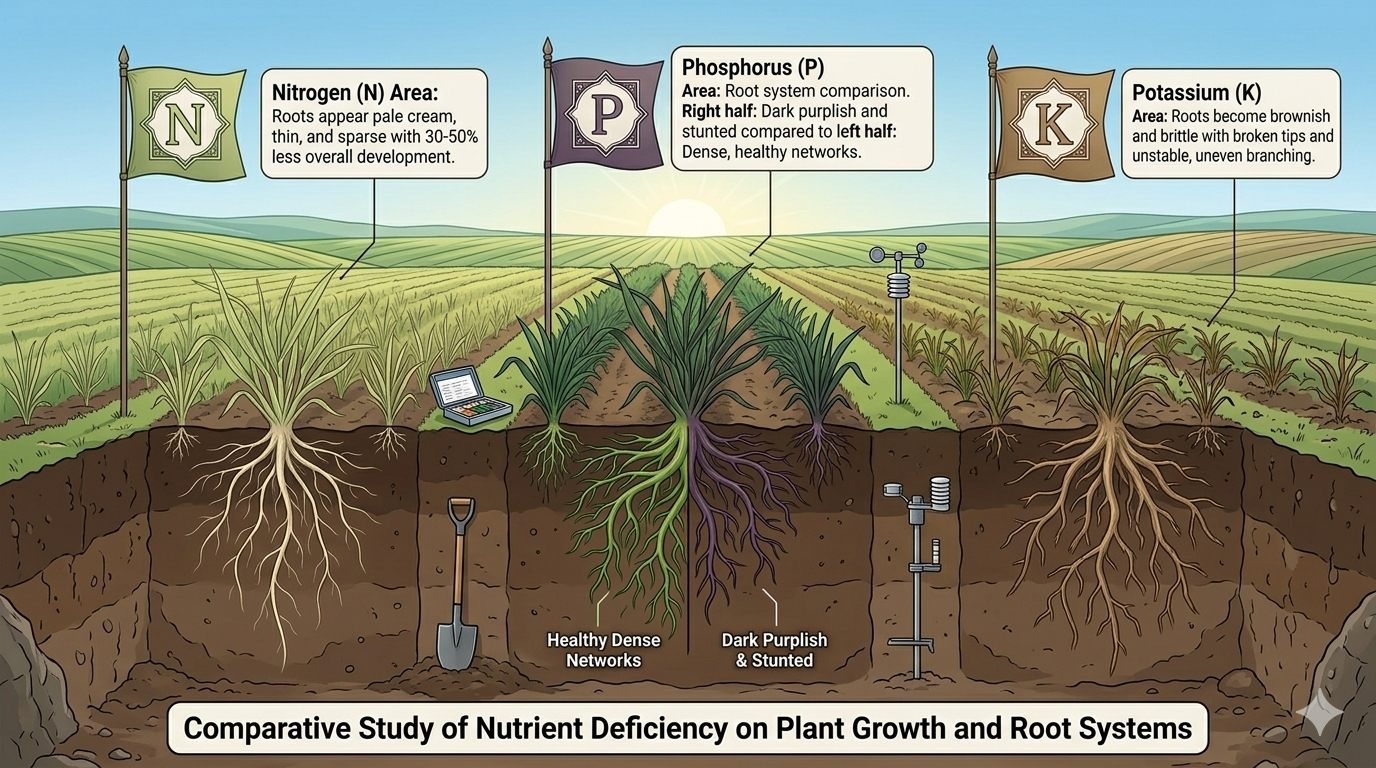
A nitrogen-starved plant produces roots that appear thin, pale cream-colored, underdeveloped, and sparsely distributed in the soil. The overall root mass may decline dramatically, reducing the plant’s ability to absorb moisture and nutrients efficiently.
Since nitrogen is directly involved in protein synthesis and cell formation, deficient plants struggle to generate new root tissue. Root elongation slows down, secondary root formation decreases, and microbial activity around the rhizosphere weakens.
In practical farming conditions, nitrogen-deficient crops often show:
- Reduced root density
- Weak feeder roots
- Poor water uptake
- Lower nutrient absorption efficiency
- Increased drought sensitivity
- Delayed recovery after stress
Plants suffering from chronic nitrogen deficiency frequently remain stunted even after late fertilizer correction because the root system never fully develops.
Another important consequence is reduced microbial synergy. Beneficial microorganisms around the root zone depend heavily on root exudates, which decline when nitrogen availability becomes limited. This weakens the natural biological activity of the soil.
Phosphorus Deficiency: When Roots Lose Their Branching Power
Among all nutrient deficiencies, phosphorus deficiency has one of the most visible impacts on root architecture.
Phosphorus-deficient plants develop poorly branched root systems with reduced lateral root formation. The roots often become dark purplish or reddish due to anthocyanin accumulation triggered by metabolic stress.
Instead of producing dense and aggressive underground networks, phosphorus-starved plants generate thin, weak roots with limited exploration capacity. The plant essentially loses its ability to efficiently search the soil for water and nutrients.
This becomes especially dangerous during early crop stages because phosphorus is critical for seedling establishment. Weak root initiation during this period can permanently limit crop performance.
Common signs of phosphorus-deficient roots include:
- Reduced branching
- Dark or purplish root coloration
- Stunted root expansion
- Delayed root establishment
- Poor nutrient mobility
- Weak transplant recovery
Cold soils, compacted soils, acidic conditions, alkaline soils, and poor microbial activity can all reduce phosphorus availability even when phosphorus exists in the soil.
One of the most overlooked issues in modern agriculture is phosphorus fixation. In many soils, phosphorus becomes chemically locked and unavailable to plants. This creates deficiency symptoms despite fertilizer application.
Healthy phosphorus management therefore requires more than simply adding fertilizer. Soil biology, pH management, organic matter, and microbial activation all play crucial roles in making phosphorus available to roots.
Potassium Deficiency: Weak Roots and Fragile Plant Foundations
Potassium deficiency primarily damages root strength, structural stability, and stress resistance.
Unlike nitrogen and phosphorus deficiencies that mainly reduce growth, potassium deficiency weakens the physical integrity of the root system itself. Roots become brownish, brittle, unevenly branched, and prone to tip damage.
Potassium regulates water movement and osmotic balance within plant cells. Without adequate potassium, roots lose their ability to maintain proper hydration and cellular pressure. This causes fragile tissues and poor resistance against environmental stress.
Plants lacking potassium often experience:
- Broken or damaged root tips
- Weak anchorage
- Irregular branching
- Increased susceptibility to drought
- Greater disease vulnerability
- Reduced tolerance to salinity and heat
Potassium-deficient plants are also less efficient at transporting sugars and energy throughout the plant system. As a result, roots receive less energy for growth and maintenance.
One important field observation is that potassium-deficient crops often collapse faster under stress conditions than crops deficient in nitrogen or phosphorus. Their weakened root integrity leaves them unable to withstand environmental pressure.
The Relationship Between Roots and Soil Microbiology
Healthy roots do not work alone. They function in partnership with billions of microorganisms living around the rhizosphere.
When NPK deficiencies occur, this underground ecosystem becomes disrupted.
Weak roots release fewer beneficial exudates such as sugars, amino acids, and organic compounds that feed microbial populations. Reduced microbial activity then further decreases nutrient solubilization and nutrient cycling.
This creates a dangerous downward spiral:
Weak nutrition → weak roots → weak microbes → lower nutrient availability → even weaker roots.
This is why biologically active soils often recover from deficiencies faster than chemically exhausted soils. Strong microbial ecosystems improve nutrient availability, root stimulation, and stress buffering.
Environmental Factors That Worsen NPK Deficiencies
Many growers assume nutrient deficiency always means insufficient fertilizer. In reality, nutrient lockout is often the bigger problem.
Several soil and environmental conditions can prevent roots from absorbing nutrients properly:
- Incorrect soil pH
- Waterlogging
- Soil compaction
- Excess salinity
- Poor aeration
- Low microbial activity
- Excessive chemical fertilizer use
- Drought stress
- Cold soil temperatures
Even nutrient-rich soils can produce deficiency symptoms when roots become physiologically stressed.
This is why root health management must always accompany fertilizer management.
Practical Ways to Protect Root Systems from NPK Deficiencies
The most successful growers focus on prevention rather than correction. Once root systems are severely compromised, complete recovery becomes difficult.
Several practices can help maintain healthy NPK balance and stronger root architecture:
Maintain balanced nutrition instead of excessive single-nutrient feeding. Overuse of one nutrient can suppress the uptake of others.
Regular soil testing helps identify hidden deficiencies before visible symptoms appear.
Improve soil organic matter to enhance nutrient buffering and microbial activity.
Avoid overwatering and compaction because oxygen-starved roots absorb nutrients poorly.
Use biologically active formulations and microbial stimulants to improve nutrient solubilization and rhizosphere activity.
Maintain proper soil pH because nutrient availability sharply declines outside the optimal range.
Encourage deeper rooting through proper irrigation management rather than shallow frequent watering.
Strong Roots Build Strong Agriculture
Every productive crop begins underground.
Leaves may capture sunlight, but roots determine whether the plant can truly thrive. Nitrogen builds root mass, phosphorus drives root expansion, and potassium strengthens root integrity. Together, they create the biological engine that powers the entire plant.
When these nutrients become deficient, the root system weakens first — often long before growers recognize visible symptoms above the soil surface.
Understanding root responses to NPK deficiencies allows farmers, gardeners, and agronomists to make smarter decisions about soil management, fertilization, irrigation, and biological activation. Healthy roots are not merely a support structure; they are the foundation of crop productivity, resilience, and long-term soil sustainability.
#NPK #NitrogenDeficiency #PhosphorusDeficiency #PotassiumDeficiency #PlantRoots #RootHealth #PlantNutrition #SoilHealth #SustainableAgriculture #CropManagement #OrganicFarming #PlantScience #Agriculture #HealthySoil #FarmingTips