


How Deep Should You Plant a Seed?
The right seed in the right soil is only half the job the real beginning of a healthy crop is getting the seed to the right depth
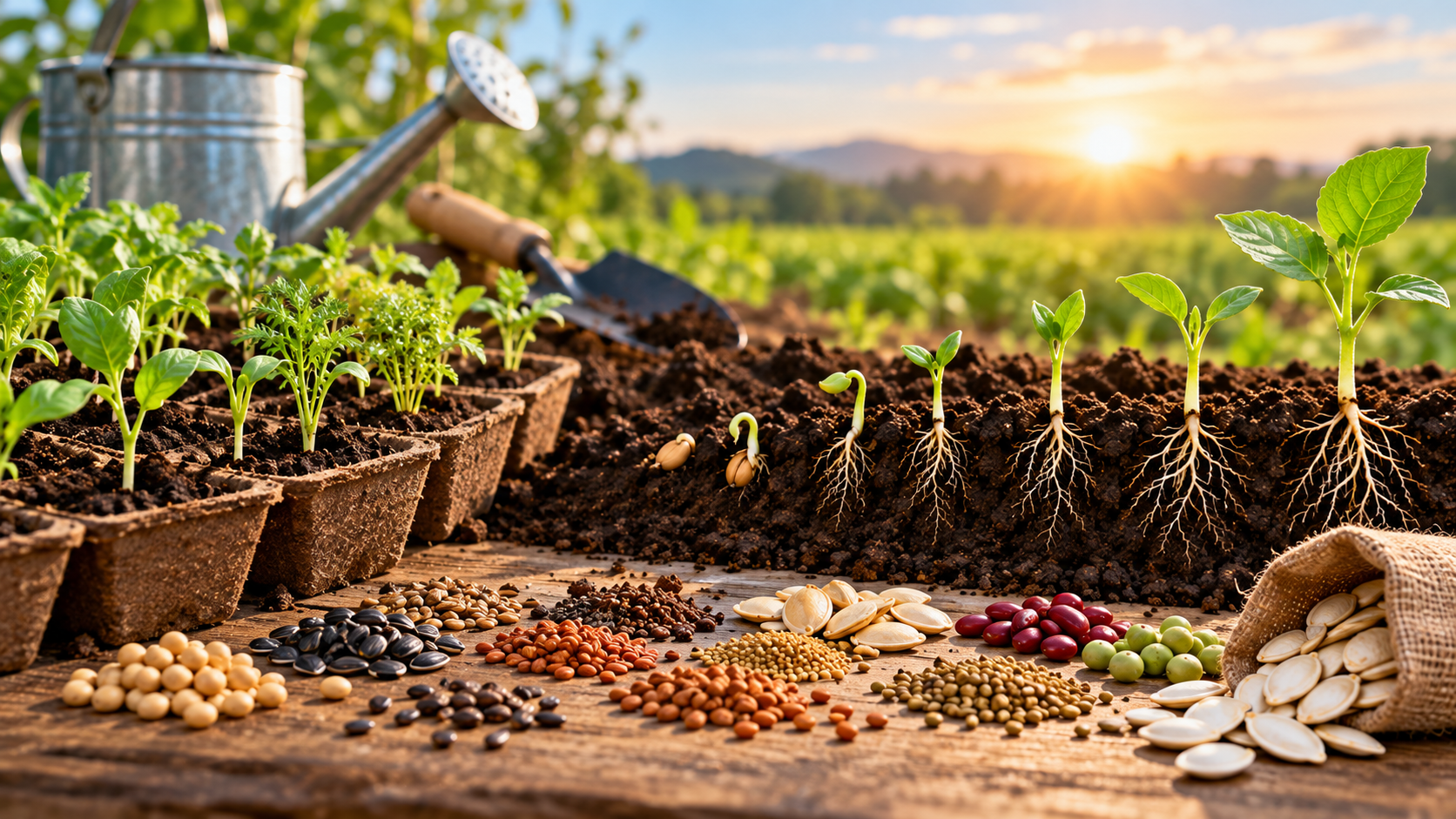
A seed may look insignificant, but it carries everything needed to begin a new plant. Give it moisture, oxygen, warmth and suitable soil, and the transformation begins. Yet one of the simplest mistakes in sowing can prevent that transformation from happening properly: planting the seed too deep or too shallow.
Seed depth influences how quickly a seed absorbs moisture, how much energy the emerging seedling must spend reaching the surface, how well the seed is protected from drying and how successfully the young plant establishes its roots.
For farmers, gardeners and anyone raising crops from seed, understanding planting depth is therefore not a minor technical detail. It is one of the foundations of successful crop establishment.
The Golden Rule: Seed Depth Is Related to Seed Size
When there is no specific recommendation available, a useful starting point is to plant most seeds at approximately two to three times the seed's width or diameter. The seed packet or crop-specific recommendation should always take priority because different crops and varieties can have different requirements.
This explains why tiny seeds such as celery, lettuce and some herbs are generally sown very close to the soil surface, while larger seeds such as beans, peas and some cucurbits can be placed considerably deeper.
Think of the seed as carrying a limited amount of stored energy. The seedling must use that energy to push its shoot upward until it reaches light.
Too much soil above the seed means a longer and harder journey. Too little soil can leave the seed vulnerable to drying, washing away, temperature fluctuations and poor contact with moist soil.
Why Planting Depth Matters So Much
A germinating seed needs more than water. It needs a favourable balance of moisture, oxygen, temperature and physical conditions around the seed.
When a seed is planted at an appropriate depth, the surrounding soil helps maintain moisture while still allowing oxygen to reach the seed. Good seed-to-soil contact also helps the seed absorb water consistently.
If the seed is too shallow, the upper layer of soil can dry quickly. The seed may also be exposed to birds, insects or heavy rain, and rainfall or irrigation can move it from its original position.
If it is planted too deeply, the emerging seedling may exhaust much of its stored energy before reaching the surface. This can result in slow, weak or uneven emergence.
The objective is therefore not to bury a seed as deeply as possible. The objective is to place it where the seed can germinate and emerge with the least unnecessary stress.
Small Seeds Need a Different Approach
One of the most common sowing mistakes is treating every seed in the same way.
Very small seeds contain limited food reserves. They generally cannot tolerate being buried under a thick layer of soil.
Seeds such as celery and many fine-seeded herbs and flowers may require only a very light covering, while some species actually require light for germination and should remain on or very near the soil surface.
For extremely fine seed, a practical technique is to prepare a fine, moist seedbed, distribute the seed evenly and press it gently against the surface rather than creating a deep furrow.
A light mist of water can then provide moisture without disturbing the seed.
This is particularly important because a heavy stream of water can bury small seeds deeper than intended.
Medium-Sized Vegetable Seeds
Many common vegetable seeds fall into the middle range and can generally tolerate a shallow covering of soil.
Carrot, radish, lettuce, spinach, tomato and similar crops should not automatically be treated like large bean or squash seeds.
For small and medium vegetable seeds, the goal is usually a shallow, uniform planting depth combined with good seed-to-soil contact.
Carrot and radish seeds, for example, are small enough that excessive depth can make emergence unnecessarily difficult. On the other hand, leaving them completely exposed can allow the seedbed to dry rapidly.
A finely prepared surface, shallow sowing and gentle irrigation are often more important than simply adding more soil.
Large Seeds Can Go Deeper
Larger seeds generally contain greater food reserves and produce stronger emerging seedlings. This allows them to be planted deeper than fine seeds.
Beans, peas, corn and several large-seeded vegetable crops commonly tolerate deeper sowing than crops with tiny seeds. Exact depth still depends on the crop, soil condition and growing environment.
For large seeds, good contact with moist soil is particularly important.
A seed sitting in an air pocket may have access to moisture only intermittently. Firming the soil gently around the seed helps eliminate large air gaps without compacting the entire seedbed.
The Soil Type Changes the Equation
The same seed should not necessarily be planted at exactly the same depth in every soil.
In light, sandy soil, water drains more quickly and the surface can dry rapidly. Seeds may sometimes be placed somewhat deeper to access more consistent moisture.
In heavy clay or poorly drained soil, planting too deeply can create problems because the seed may encounter restricted aeration and excessive moisture. Shallow planting is generally safer than burying the seed deeply in such conditions.
This is one reason why a planting-depth chart should be treated as a starting guide rather than an absolute rule.
The condition of the actual seedbed matters.
Moisture Is Just as Important as Depth
Imagine planting a seed at the perfect depth but placing it into completely dry soil.
The depth is correct, but germination may still fail.
Seeds need to absorb water to initiate germination. Therefore, planting should ideally be done when adequate moisture is available around the intended seed zone.
At the same time, excessive water can remove oxygen from soil pores and create conditions that are unfavourable for germinating seeds.
The objective is moist soil, not waterlogged soil.
For direct sowing, gently moistening the planting furrow before placing the seed can be useful when the surrounding soil is dry. After sowing, irrigation should be gentle enough to avoid washing seeds away or creating a crust over the soil surface.
Seed-to-Soil Contact: The Overlooked Factor
Depth alone does not guarantee good germination.
A seed needs intimate contact with surrounding soil so that moisture can move toward it. If the seed is sitting in a loose cavity, surrounded by air pockets, it may not receive moisture consistently.
After sowing, lightly firming the soil over the seed can improve contact.
But there is an important distinction:
Firming the soil is not the same as compacting the soil.
Excessive compaction can reduce pore space, restrict oxygen movement and make it harder for emerging roots and shoots to develop.
The ideal seedbed is loose enough for roots to grow, but sufficiently settled around the seed to provide good contact.
Why "Deeper Is Better" Is a Dangerous Idea
Some growers believe that deeper planting protects seeds from heat and drying. While moisture availability is important, deeper is not automatically better.
Every emerging seedling has to push through the soil above it.
As the distance increases, the young shoot must spend more of its stored energy before it reaches the surface. If the seedling becomes exhausted before emergence, establishment can suffer.
This is particularly important for small seeds with limited reserves.
A seed should be planted deep enough to establish good contact and moisture—but not so deep that emergence becomes an unnecessary obstacle.
Why Very Shallow Planting Can Also Fail
The opposite mistake is equally common.
A seed placed almost on top of dry soil may absorb insufficient water to complete germination. It may germinate after irrigation and then dry out again. Heavy rain can also expose or move it.
Very shallow seeds are additionally more vulnerable to temperature fluctuations and disturbance.
For this reason, even when a seed requires shallow sowing, it should still have consistent moisture and good contact with the growing medium.
Understanding the Seed Planting Depth Guide
The image accompanying this article illustrates a useful concept: different crops have different approximate sowing depths.
Very shallow crops such as basil, lettuce and celery belong near the surface.
Crops such as carrot, parsley and radish generally require a little more covering.
Tomato, pepper and eggplant are typically started from relatively shallow seed placement, particularly when raised in nursery trays.
Crops such as spinach and beet can tolerate somewhat greater depth.
Larger seeds such as bush beans, peas and fava beans can generally be planted deeper because of their larger seed reserves.
And crops represented by seed potato, winter squash and zucchini require a completely different planting approach because of their substantially larger planting material or seeds.
The exact number shown on a general guide should never override the instructions supplied for a particular variety, seed lot or production system.
A Simple Way to Measure Seed Depth
You do not need sophisticated equipment to achieve reasonably consistent sowing depth.
For small-scale cultivation, a ruler, measuring stick, dibber, finger or appropriately calibrated planting tool can be used.
For larger farms, seed drills and precision planters can be adjusted according to crop requirements.
The important point is consistency.
If one seed is planted at ½ inch and another at 2 inches in the same row, emergence may occur unevenly. The result can be a crop with seedlings at different stages of development.
Uniform depth contributes to more uniform emergence.
Planting Depth and Seedling Emergence
Uniform emergence is particularly important in commercial vegetable production.
When seedlings emerge at approximately the same time, they have a more similar starting point for growth and competition for light, water and nutrients is easier to manage.
Uneven emergence can create a mixed crop where some plants are already established while others are still emerging.
This can affect subsequent irrigation, intercultural operations, crop protection and harvesting schedules.
Therefore, correct seed depth is not simply about getting the first seedling out of the ground. It is about establishing a uniform crop stand.
Do Not Confuse Seed Depth With Transplanting Depth
Another important distinction is between sowing a seed and transplanting an established seedling.
The planting-depth principles for a seed do not automatically apply to a transplant.
A young nursery plant already has an established root system and shoot. Its transplanting depth should be determined according to the crop and its tolerance for being planted deeper.
For example, some crops can tolerate deeper planting than others, while certain vegetables should generally be transplanted with the root ball at approximately its original level.
Treat the seed and the established plant as two different stages of crop establishment.
Seed Depth Is Only One Part of Successful Germination
Even perfect planting depth cannot compensate for poor-quality seed or unsuitable growing conditions.
Successful establishment depends on several factors working together:
Seed quality determines germination potential.
Soil moisture activates the germination process.
Temperature influences the speed of germination and early growth.
Oxygen availability supports the metabolic activity of the germinating seed.
Seed-to-soil contact helps maintain access to moisture.
Soil structure determines whether roots and emerging shoots can move through the seedbed.
Seed depth determines how much soil the emerging seedling must overcome.
This is why good sowing is a combination of several small decisions rather than one isolated measurement.
Five Practical Rules Every Grower Should Remember
First: Check the seed packet.
If the seed supplier provides a recommended sowing depth, use it as the primary guide.
Second: Consider seed size.
When no specific recommendation is available, use the seed's width or diameter as a starting point. A depth of roughly two to three times the seed diameter is a useful general rule.
Third: Consider the soil.
Sandy soil, clay soil, raised beds and nursery media can behave differently.
Fourth: Protect the seedbed after sowing.
Avoid strong irrigation that can expose, move or bury seeds.
Fifth: Aim for uniformity.
Consistent depth and moisture help produce a more uniform crop stand.
A Better Question Than "How Deep Should I Plant?"
Instead of asking only, "How deep should this seed go?", ask five questions:
How large is the seed?
What depth does this crop or variety recommend?
What is the moisture condition of my soil?
Is my soil sandy, loamy or heavy?
Will the seed have enough moisture, oxygen and energy to emerge from that depth?
These questions lead to much better sowing decisions than following a single number blindly.
The Bottom Line
Successful crop production often begins with details that appear almost too simple to matter.
Seed planting depth is one of those details.
A seed buried too deeply may struggle to emerge. A seed placed too shallowly may dry out or become displaced. The correct depth creates a practical balance between moisture, protection, oxygen availability and emergence.
There is no single planting depth that works for every crop. Seed size, crop type, variety, soil texture, moisture, season and growing conditions all matter.
So before sowing the next crop, remember one simple principle:
Don't just plant the seed in the soil, place it where the seed has the best chance to become a strong plant.
#SeedPlanting #SeedDepth #SeedSowing #SeedGermination #CropEstablishment #GardeningTips #FarmingTips #OrganicFarming #VegetableGardening #Agriculture #Horticulture #FarmerTips #PlantGrowth #SeedlingCare #SmartFarming